How Do You Compete Against the Builders? Selling Your Home in a Neighborhood Dominated by New Construction
October 27, 2026
by Elena Garrett, Realtor – Oct 2026
You bought a beautiful new home just a few years ago. You invested in upgrades, made it your own, and took good care of it. Now you’re ready to sell.
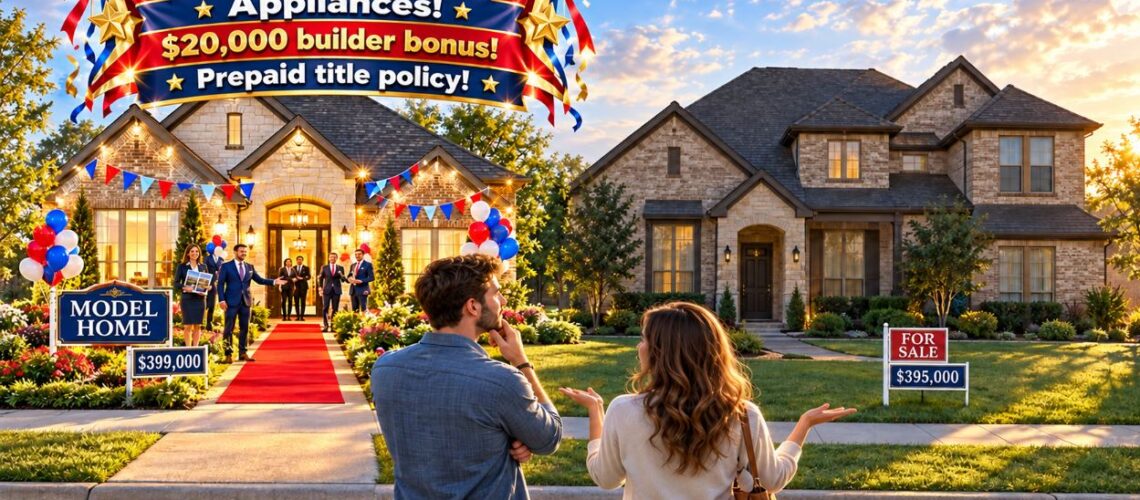
There’s just one problem. Your area is still growing. Builders are still building. And some of those builders are offering brand-new homes at prices surprisingly close to what you paid several years ago. Worse, they’re advertising attractive mortgage rates, closing-cost assistance, appliance packages, and other incentives. Suddenly, you’re not just competing against the house down the street. You’re competing against an entire professional sales operation.
So how do you win?
The first step is understanding exactly what you’re up against. Denying the problem won’t help you. Many sellers say “But my home is just a couple of years old, buyers will love it!” No, they won’t even notice it. They will be sitting at the builder office, going over the design ideas.
1. Recognize That You’re Competing Against a Business, Not Just Another Seller
Most individual homeowners approach selling their property as a personal financial transaction. They have a mortgage balance, equity expectations, moving expenses, and a price they hope to achieve.
Builders operate differently. A builder might have dozens or even hundreds of homes to sell. They have marketing departments, preferred lenders, sales representatives, carefully furnished model homes, a slew of workers and cleaners making every home sparkling and pretty, and budgets specifically designed to generate buyer traffic. They also have something individual homeowners rarely possess: extensive sales data showing which incentives attract buyers and which objections prevent purchases.
Builders experiment with combinations of prices, financing, upgrades, and promotions. They track what works. And importantly, builders may sometimes be willing to sacrifice profit on individual homes to maintain sales volume, reduce inventory, or achieve broader business objectives.
That doesn’t mean you cannot compete. It means you need to stop thinking like a typical home seller and start borrowing some techniques from successful builders.
2. Stop Comparing Asking Prices. Compare the Actual Deals And Buyer Monthly Payments.
Imagine two houses:
- Your resale home is listed for $390,000.
- A comparable newly constructed home is advertised for $410,000.
You might reasonably assume that your home has a $20,000 competitive advantage. Right? Not necessarily.
- What if the builder offers special financing that reduces the buyer’s monthly mortgage payment?
- What if the builder also contributes toward closing costs?
- What is the builder is also providing up to $10,000 in design center updates?
Suddenly, the buyer may find the more expensive home easier to purchase. And that’s where resale sellers frequently lose buyers without understanding why.
Buyers don’t necessarily choose the lowest-priced house. They choose the combination of price, monthly payment, features, convenience, and perceived value that works best for them. Your asking price is only one component of your competitive position.
Before listing, investigate what nearby builders are actually offering:
- Advertised mortgage rates and financing incentives
- Contributions toward closing costs
- Appliance packages and included upgrades
- Inventory-home discounts
- Move-in dates and promotional offers
Pay particular attention to conditions attached to incentives, such as using the builder’s preferred lender or choosing a designated inventory home.
Then compare those packages with what you can realistically offer.
3. Borrow the Builders’ Incentives—Without Matching Their Budgets
You probably cannot match a national builder’s financing resources. Fortunately, you don’t necessarily have to. Consider what buyers actually want.
- Perhaps they’re moving from an apartment and don’t own a refrigerator, washer, or dryer. Including those appliances might make your home more attractive.
- Perhaps they’re worried about cash needed at closing. A negotiated closing-cost contribution might help more than an equivalent reduction in the purchase price.
- Or perhaps they’re recalculating their budget to figure out how to deal with rising interest rates. A contribution toward an eligible mortgage-rate buydown could be particularly interesting.
You could also consider offering the buyers other items, such as (these are just some ideas):
- Prepaying part of the HOA dues.
- Including desirable appliances or equipment already installed.
- Offering a limited home warranty.
- Providing flexibility in the closing or possession date.
- Offering credits toward specific improvements that buyers would otherwise need to finance themselves.
Of course, the incentives must comply with the buyer’s loan requirements, and their actual financial value should be calculated.
Here’s the important distinction: A $5,000 price reduction and a $5,000 buyer incentive are not necessarily perceived the same way—or produce the same financial benefit. The objective isn’t to give away money. It’s to determine where each dollar has the greatest influence on the buyer’s decision.
4. Turn the Builders’ Model Homes Into Your Own Design Consultants
Have you visited a professionally decorated builder model home recently? Builders spend considerable money discovering which colors, finishes, lighting arrangements, and furniture layouts appeal to their target buyers.
Instead of ignoring those beautiful model homes, study them. What are the builders emphasizing? Lighter colors and moods in the kitchens? Flexible living areas? Home offices? How do they present their outdoor spaces?
Now consider how you could present your existing home with some of those same design ideas. You may not need to remodel anything. Professional photography, selective staging, and carefully labeled virtual redesign concepts can help buyers imagine how the property could look with contemporary finishes.
For example, a virtually redesigned living room might demonstrate how a different paint color, lighting arrangement, or furniture style could transform the space. The original photographs should remain available, and virtual changes should be clearly disclosed. The goal is to help buyers recognize possibilities they might otherwise overlook.
And unlike a builder’s unfinished home, yours may already include ceiling fans, window treatments, upgraded fixtures, landscaping, and other improvements.
5. Sell What the Builder Cannot Deliver Immediately
A brand-new home has undeniable appeal (just think back to when you were buying a house – chances are, all other things being equal, you would prefer brand new versus pre-owned). But a resale home may have advantages that are easy to overlook unless someone explains them.
For example:
- Established upscale landscaping instead of a newly planted, builder-default yard.
- Window coverings, added design elements, and additional installed equipment like whole-house water filtration system (as long it is not leased and has a loan that needs to be paid off).
- A completed neighborhood section with better community amenities and fewer nearby construction activities.
- A particular lot, location, or floor plan that is no longer available from the builder.
- A predictable move-in timeline when the home is already complete.
One overlooked opportunity is the location within the neighborhood itself. A particular corner lot, proximity to walking trails, convenient access to major roads, or an especially desirable position within the subdivision can create meaningful differences between otherwise similar homes. Use aerial photography, neighborhood maps, and lifestyle-oriented videos to explain those advantages.
Remember: you’re not selling a generic floor plan. You’re selling a specific home in a specific location with features and conveniences that may be impossible to duplicate.
6. Make the Move Easier—and More Affordable – With Unique Opportunities That Builders Cannot Offer
Builders understand that buyers are attracted to 3 things: affordability, convenience, and warranties. Why not take your offer to them one step further?
Idea 1: Unique Savings That Builders Cannot Offer
Imagine offering buyers access to a collection of discounts from local moving companies, cleaners, packing services, storage providers, painters, landscapers, and other businesses involved in moving. The individual savings might be modest, but together they can make the transition feel considerably easier. A buyer savings program could even extend beyond closing, providing opportunities to save on services after moving into the neighborhood.
If you work with Elena Garrett as a Realtor (your listing agent), she will be able to offer all buyers interested in purchasing YOUR home many saving opportunities that the builders simply do not have access to. This is not a guaranteed way to win the builder competition, but every differentiator in your favor help you to stand out in a more positive way to prospective buyers.
Idea 2: Rent-Forward
And here’s another potential strategy: Rent-Forward. For certain situations (for example, when your home is already vacant), a carefully structured arrangement involving temporary occupancy and a later purchase may help bridge timing or financing obstacles. It isn’t suitable for every transaction and requires proper legal, lending, insurance, and contractual review.
But it’s an example of thinking creatively about the transaction itself.
The question becomes: What problem is preventing this otherwise interested buyer from purchasing our home, and is there a financially reasonable way to solve it?
7. Use Pricing to Create a Competitive Advantage, Not Just to Match the Market
This may be the most difficult lesson for many homeowners. Suppose comparable resale homes are listed between $390,000 and $420,000. It might seem reasonable to you to list yours for $399,000. Right?
Not necessarily. What if several of those competing homes have been sitting on the market for months at $390,000 price? What happens if you list your home for HIGHER than they are already failing to sell for?
Suddenly, $399,000 might place you in the middle of an extremely crowded and unattractive competitive field.
The currently available homes’ asking prices tell you what sellers want to get for their houses. They don’t necessarily tell you what buyers are willing to pay for those houses. Now add nearby builders offering special financing and incentives, and you will see how relying on other home sellers’ pricing could be a wrong strategy as the current sellers are ALREADY FAILING to attract attention with their prices.
As much the sellers do not like to hear it, the lower starting price might create a more substantial advantage by appealing to buyers considering both resale homes and new construction. However, that price needs to be calculated carefully.
For our previous example, compare what happens at with the rest of the market datapoints at these price levels: $379,000, $389,000, $399,000, and $409,000.
At each price level, ask:
- Which existing homes would be we competing against?
- Which new-construction homes within 30 min drive from our location (or within the same ISD, if your ISD has high ratings) would become realistic competitors for the same buyers at this price point?
- How do the builder incentives change the buyer’s effective cost at this price point?
- What meaningful reason does the buyer have to choose our home vs a similarly priced (adjusted for incentives) new construction homes?
Also, look deeper into your pre-owned homes competition. Check their backyard photos, the lot location in the community, read through the home descriptions to catch unusual features they might have. Don’t automatically give your property the same value as homes with premium greenbelt locations, oversized lots, backyard pool, or other special features, unless you have the same features, too. Ask your realtor for guidance on how the buyers typically value certain features, price-wise and desirability-wise.
The best listing price isn’t necessarily the price that looks most reasonable to YOU compared with other asking prices. It’s the price that gives BUYERS a clear and compelling reason to choose to visit your home before they visit your competition.
And remember that carrying costs matter. If keeping a house on the market costs several thousand dollars per month, spending three extra months chasing a higher price might produce a worse financial result than selling sooner.
8. Don’t Stop at Attracting Buyers. Learn How to Convert Their Interest Into Offers.
Here’s where I believe many traditional real estate marketing plans fall short.
Marketing generates discovery. Sales generates the actual signed purchase contract. But most owners and their agents focus on Marketing Activities, forgetting that attracting more people to visit the house only helps if one of them signs a purchase contract. The actual offer is assumed to happen on its own, magically, if only enough people visit the house. Right?
Please notice that builders do not leave the actual sale conversion to chance at all. A builder can spend thousands attracting a buyer, but its sales representatives will be very actively involved to make sure that buyer make a decision.
The same principle applies to resale homes. When a buyer visits your property, the showing should help answer the questions likely to arise during the comparison with new construction.
- What upgrades are already included? What would those cost elsewhere?
- Why is this floorplan a better choice for their needs?
- Why might this location be preferable?
- Can the seller help with financing costs?
- What other incentives are available?
- Can the seller accommodate financing contingencies?
- Is lease forward an option?
- What makes the transaction attractive?
And when an offer arrives, the negotiation shouldn’t automatically become a battle over the sales price. The sale price is just one paragraph in a 10-page long contract. What abut the rest of the terms – what can be used as a leverage to make the transaction easier for the BUYER, not for the seller? Perhaps the buyer is primarily concerned with monthly payments. Perhaps they’re worried about immediate expenses after closing. Perhaps closing flexibility matters more than a small price difference.
If we do not know about their concerns up front, negotiating on price completely misses the mark from the BUYERS perspective. Understanding those priorities can create negotiating opportunities.
This is where advanced selling approaches, including selected elements of the 72SOLD strategy, may provide useful tools: stronger buyer engagement, more deliberate presentation, learning about buyer motivations, and creatively structuring negotiations.
9. Remember That Your Home Does Not Have to Win Every Buyer
This is perhaps the most encouraging part. You do not have to outsell an entire subdivision. You don’t need to convince every person shopping for new construction that resale homes are better. You need to attract the relatively small number of buyers for whom your home offers the best combination of location, size, condition, features, price, and financial terms.
- For one buyer, that’s the established backyard.
- For another, it’s the additional bedroom or larger living area.
- For someone else, it’s the ability to move immediately without waiting for the sale of their own current house to close.
- And for another, it may be the financial package that makes the monthly payment or upfront expenses more manageable.
Your job is to identify those advantages, explain them clearly, and make them relevant to the buyers most likely to appreciate them.
Final Thoughts: Don’t Try to Outsmart the Builders. Outsmart the Competition.
Builders have tremendous advantages. They have scale, marketing budgets, financing relationships, and professionally trained sales teams.
But many individual homeowners are in a position to offer something else: flexibility.
You can customize the offer. You can negotiate different terms. You can emphasize unique property features. You can offer conveniences that may not be part of a builder’s standardized package. Most importantly, you can build a selling strategy around the actual competitive conditions rather than following a generic listing checklist.
When you’re surrounded by new construction, the solution isn’t necessarily to make your home look newer or simply keep lowering the price. It’s to make your home the smarter purchase among the options that the buyers have.
72sold advertising opportunities artículos en español blog buy4cash buyers Canadian citizens cash offers creative financing dfw housing market update events financial fitness for buyers for homeowners for investors for renters for sellers holidays home purchase contracts and forms houses industry news international home buyers itin knowledge articles legal and financial market updates monthly updates mortgage moving to Texas North Texas homes owner financed houses RECA educational center rent-to-own seller financed houses selling as-is special program stats stats and trends taxes tips and tricks vendor resources videos videos for home buyers videos for investors videos for sellers