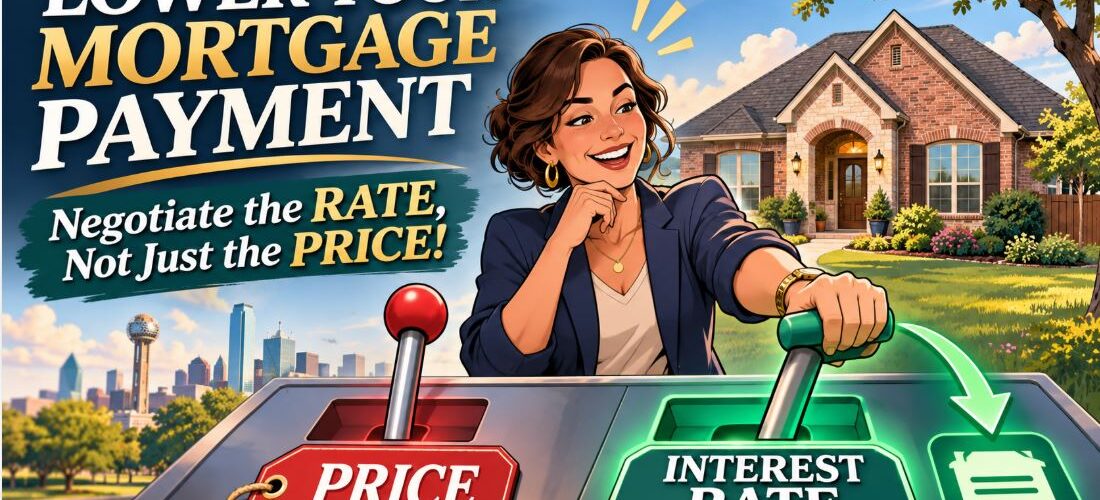
Want a Lower Mortgage Payment? Don’t Just Negotiate the Price. Negotiate the Interest Rate!
November 6, 2026
by Elena Garrett, Realtor, KW Central | Nov 2026
Why lowering the purchase price isn’t always the most effective way to make a home more affordable
You’ve found a house you love. It’s listed for $300,000, and it’s almost perfect. The location works. The size is right. It has the features you need.
There’s just one problem. When you calculate your monthly mortgage payment, it comes out to approximately $2,918. That’s more than you wanted to spend.
So what’s your first thought? “Maybe we can get the seller to lower the price!” That’s a perfectly reasonable idea. In fact, negotiating the purchase price is one of the first strategies most homebuyers think about.
But here’s something that might surprise you. Lowering the purchase price doesn’t always lower your monthly payment nearly as much as you might expect. And sometimes the seller simply isn’t interested in reducing the price. Does that mean you’re out of options? Absolutely not!
There’s another negotiating strategy I want you to understand, because it could make a much bigger difference in your monthly payment. Let’s look at the numbers.
First, What Happens If We Negotiate $10,000 Off the Price?
Let’s take our $300,000 house. For this example, we’ll assume:
- A 30-year FHA mortgage.
- A 3.5% down payment.
- A 6.875% mortgage interest rate.
- Property taxes of $680 per month.
- Homeowners insurance of $170 per month.
Including FHA mortgage insurance, our estimated total monthly payment comes to approximately $2,918.
Now let’s say we’re successful in negotiating with the seller. We offer $290,000 instead of $300,000. And the seller accepts! Congratulations! You’ve just negotiated $10,000 off the purchase price. That’s certainly an accomplishment.
But here’s my question: How much did that $10,000 price reduction actually save you on your monthly mortgage payment? Let’s calculate.
| Original price | Negotiated price | |
|---|---|---|
| Purchase price | $300,000 | $290,000 |
| Down payment | 3.5% | 3.5% |
| Interest rate | 6.875% | 6.875% |
| Monthly principal and interest | $1,935 | $1,871 |
| Monthly principal-and-interest savings | $64 |
Wait a minute. You negotiated $10,000 off the price, but your principal-and-interest payment dropped by only about $64 per month? Yes!
You would also save a little on mortgage insurance, and there might be additional savings if the property’s taxes or insurance costs were lower. But those costs don’t necessarily decrease in proportion to the negotiated price. If taxes and homeowners insurance stayed the same in this example, your total estimated payment would fall from approximately $2,918 to $2,849.
That’s about $69 per month in savings. Now, I’m certainly not suggesting that saving $10,000 on a house is a bad thing! A lower purchase price has other advantages. You’re borrowing less money, putting less money down, and potentially reducing the total interest you’ll pay. But if your primary goal is to make that monthly mortgage payment significantly smaller, a $10,000 price reduction might not accomplish nearly as much as you hoped.
So what else could we negotiate?
What If We Negotiated a Lower Interest Rate Instead?
Here’s where things get interesting. Many buyers don’t realize that we can sometimes negotiate for the seller to contribute money toward lowering the buyer’s mortgage interest rate.
This is called an interest-rate buydown. Instead of asking the seller to lower the purchase price, we ask the seller to help pay the lender for a lower mortgage rate.
For our example, let’s assume we’ve successfully negotiated that assistance. The seller has agreed to help us buy down your interest rate. Now let’s see what happens to the monthly payment on that same $300,000 house.
Same House. Same Price. Different Mortgage Rates.
| Mortgage interest rate | Total monthly payment | Monthly savings |
|---|---|---|
| 6.875% | $2,918 | — |
| 6.750% | $2,893 | $25 |
| 6.650% | $2,874 | $44 |
| 6.500% | $2,845 | $73 |
| 6.000% | $2,749 | $169 |
Look at that last number! We’ve reduced your estimated monthly payment from $2,918 to $2,749. That’s $169 in monthly savings!
And we didn’t have to negotiate a lower price. We didn’t have to choose a different house. We didn’t have to come up with a bigger down payment. Instead, we negotiated for the seller to help us obtain more favorable financing.
Of course, the lender must confirm that the 6% rate is available and what it would cost to obtain it. For this example, we’re assuming the seller’s agreed contribution is enough to cover that cost. But look at what these calculations tell us.
Compare the Two Strategies
SAME $300,000 HOME · TWO DIFFERENT STRATEGIES
Negotiate $10,000 off the price:
$64/mo
Approximate principal-and-interest savings
Seller-funded rate reduction to 6%
$169/mo
Principal-and-interest savings if the lower rate is secured
These examples do not assume the same cost to the seller. The permanent buydown requires lender pricing; the price reduction also lowers the loan balance. This compares their effects on monthly principal and interest, not their total financial value.
Now do you see why I want buyers to think beyond the purchase price? A lower price can absolutely be beneficial. But when you’re trying to reduce your monthly housing payment, the interest rate may be a much more powerful lever than you realized.
And the best part? You don’t have to choose a strategy before you understand the numbers. We can compare different ways to structure the purchase and see which one gets you closer to your goal.
But What If the Seller Won’t Lower the Price?
This is another situation I encounter. You find a home you like, but the seller isn’t interested in reducing the asking price. Perhaps they’ve already lowered it. Perhaps they believe it’s priced correctly. Perhaps they need to achieve a certain sales price. Whatever the reason, they aren’t willing to accept a lower offer.
Many buyers assume that’s the end of the negotiation. But here’s what I would suggest. Let’s find out whether the seller would consider helping with your financing costs instead.
Sometimes sellers who don’t want to reduce their asking price may still be willing to negotiate a contribution toward the buyer’s closing costs or interest-rate buydown.
It still costs the seller money, of course. So there’s no guarantee they’ll agree. But it’s a different way to structure the transaction, and it may be worth exploring. After all, if your biggest concern is the monthly payment, why should we limit ourselves to negotiating only the purchase price?
What If We Need Even More Monthly Savings?
Now let’s consider another possibility. Suppose you tell me: “Elena, I really want to buy this house, but we’re going to have a lot of expenses during the first couple of years. Is there any way to make the payments even lower initially?“
Actually, there might be. Instead of permanently reducing your mortgage interest rate, we could negotiate for the seller to fund a temporary interest-rate buydown.
One common arrangement is called a 2-1 buydown.
Essentially, the seller contributes money to help subsidize your mortgage payments during the first two years. Let’s see what that could look like.
| Period | Estimated monthly payment | Your monthly savings |
|---|---|---|
| First year | $2,542 | $376 |
| Second year | $2,725 | $193 |
| Third year onward | $2,918 | — |
Now we’re talking about a much bigger reduction during that first year. Instead of paying almost $2,920 per month, you’re paying approximately $2,540. That’s about $376 less every month during your first year of homeownership. In our example, the seller would contribute approximately $6,826 to fund the temporary payment subsidy, subject to the lender’s final calculation and approval.
Think about what those savings could mean during your first year. Moving expenses. Furniture. Building up your emergency fund. Simply having a little more room in your monthly budget while you’re settling into the house.
There’s just one thing we need to be absolutely clear about. This reduction is temporary. Your actual mortgage note rate remains 6.875%.
In the third year, the subsidy ends, and your payment returns to approximately $2,918, assuming your other housing costs haven’t changed.
So this strategy is appropriate only when you can comfortably afford the full payment after the subsidy expires. You also need to qualify for the mortgage using the full rate. Still, for the right buyer, negotiating temporary payment assistance can be a valuable way to make the transition into homeownership easier.
So How Do We Decide What to Negotiate?
This is where I believe working with a knowledgeable buyer’s agent can make a real difference. Before we make an offer, I want to understand what you’re actually trying to accomplish. Because different buyers need different solutions.
For example:
- Buyer #1: “I have enough money for closing. I just want my monthly payment to be lower.” Then we should investigate whether negotiating a permanent interest-rate buydown would help.
- Buyer #2: “I can afford the full payment, but I’d love to have lower expenses during my first two years.” Then we might explore a temporary buydown.
- Buyer #3: “My monthly payment is fine. I’m just worried about how much cash I need to close.” Then perhaps we should negotiate for the seller to cover eligible closing expenses instead.
- Buyer #4: “I want to borrow less and minimize the total amount I pay for the house.” Then a lower purchase price may be exactly what we should prioritize.
See the difference? There’s no single negotiating strategy that’s best for every buyer. What matters is finding the strategy that addresses your particular financial priorities.
How Much Can a Seller Help?
For an FHA purchase, sellers can generally contribute up to 6% of the sales price toward allowable buyer expenses, subject to lender and FHA requirements. On a $300,000 home, that could potentially mean up to $18,000 in eligible seller contributions. That doesn’t mean every seller will agree to contribute that much—or that every transaction will have enough allowable expenses to use it. But it does give us room to explore different negotiating strategies.
Seller contributions can potentially be used toward eligible closing costs, prepaid expenses, and permanent or temporary interest-rate buydowns. They cannot simply replace the buyer’s required FHA down payment. The important thing is to understand what’s available and decide which use of the money would benefit you most.
Before You Give Up on a Home, Let’s Work on the Numbers
Here’s what I really want you to take away from this article.
The first monthly payment you see on a mortgage calculator isn’t necessarily the final payment you have to accept. It’s a starting point. If the payment is too high, we can ask some questions.
- Could we negotiate a lower price?
- Would a permanent interest-rate buydown help more?
- Could a temporary buydown make the first two years easier?
- Is the seller willing to contribute toward financing costs?
- Are there other loan programs or incentives worth investigating?
We won’t always find a solution that gets us to your ideal payment. And I would never encourage you to purchase a home you can’t comfortably afford. But I also don’t want you to give up on a house simply because the first calculation came out higher than you hoped.
Let’s find out what options we have before we decide. Because buying a home isn’t just about finding a property within your price range. It’s also about understanding how the purchase can be structured to fit your financial goals. And sometimes, a little creativity in the negotiation can make a surprisingly big difference.
Remember:
You don’t just negotiate what you pay for the house. You can also negotiate how much it costs you to buy it.
And if your goal is a more affordable monthly payment, that’s a conversation worth having.
About the calculations: These examples use a $300,000 home purchase, a 30-year FHA mortgage with 3.5% down, an initial 6.875% interest rate, estimated monthly property taxes of $680, homeowners insurance of $170, and FHA mortgage insurance. Permanent and temporary interest-rate buydowns require lender approval. Actual rates, discount-point costs, seller contributions, property taxes, and insurance expenses vary.
72sold advertising opportunities artículos en español blog buy4cash buyers Canadian citizens cash offers creative financing dfw housing market update events financial fitness for buyers for homeowners for investors for renters for sellers holidays home purchase contracts and forms houses industry news international home buyers itin knowledge articles legal and financial market updates monthly updates mortgage moving to Texas North Texas homes owner financed houses RECA educational center rent-to-own seller financed houses selling as-is special program stats stats and trends taxes tips and tricks vendor resources videos videos for home buyers videos for investors videos for sellers