
Buying A New Home While Needing To Sell The Old House – A Ton of Confusing Options
August 16, 2026
By RECA Center & Elena Garrett, Realtor in Dallas, TX
Sally and Michael were ready for a different house. They had owned their current home for years, had built up a substantial amount of money in it, and felt like they were finally in a position to move. At first, the plan seemed simple: sell this house, buy another one, and move.
Then they started asking questions.
Michael talked to a lender. Sally called an agent they knew from way back when they looked for a house a few months back. They watched videos online, read articles, and asked friends who had recently moved. The more people they talked to, the more options they discovered—and the less certain they became about what they were actually supposed to do.
One person told them to sell first because it was the safest approach. Someone else told them never to sell until they knew where they were going. Another person suggested finding the new house first and making the purchase dependent on selling their current home. Then Michael found a video about bridge loans. Sally read an article about refinancing. Someone mentioned a Buy-Before-You-Sell program. A friend suggested they simply carry both houses for a month or two.
That last suggestion sounded easy enough until Sally asked, “What if it isn’t a month or two?”
Then came more ideas. Maybe they could take out a line of credit. Maybe they could negotiate extra time in their old house after selling it. Maybe the seller of the new house would finance part of the purchase. Maybe they could find a house with a mortgage they could assume. By the end of the week, Sally and Michael had learned about more ways to move than they had ever imagined.
Unfortunately, they were now more confused than when they started.
Every solution seemed to fix one problem while creating another. Selling first would give them the money from their current house, but it could leave them scrambling to find the next one. Buying first sounded much more comfortable, but they weren’t sure they could qualify while still owning their current home. Making the purchase dependent on their current house selling seemed reasonable, but what if the seller of the new house refused?
Refinancing could potentially give them cash before the sale, but it would also increase the debt on the house they were planning to leave. A bridge loan could make some of their future sale money available sooner, but Michael wanted to know what that would cost. A Buy-Before-You-Sell program sounded convenient, but neither of them understood exactly what they would be paying for or whether the convenience was worth it.
The biggest problem was that everyone seemed to be answering a different question. One person focused on monthly payments. Another focused on qualifying for the next mortgage. Another cared about how strong their offer would look to a seller. Someone else talked only about how quickly their current home might sell.
Sally finally said, “I don’t think we need more options. I think we need a way to compare the options we already have.”
Not long afterward, Sally and Michael met Elena, a real estate agent, at an open house event. They expected her to hear their situation and immediately tell them which strategy she preferred. Instead, Elena started asking questions.
Questions that Elena asked were sometime difficult to answer outright.
How much was their current house worth? How much did they still owe on it? How much were they thinking about spending on the next house? How much cash did they want to put down? What monthly payment would feel comfortable? Could they qualify for the new house while still owning the old one? How long could they tolerate carrying two houses if they had to? How quickly was their current home likely to sell? And how important was it to them to move into the new house before putting the old one on the market?
Then Elena said, “Why don’t we calculate each option?”
Elena wasn’t suggesting that they watch another video or memorize another financing term. She was suggesting that they take each possible strategy and ask what would actually happen to Sally and Michael if they used it.
How much money would they have available? How much would they owe? How much would the solution cost? Would it make it easier or harder to buy the house they wanted? Would it put pressure on them to sell quickly? Would it make moving easier or more complicated? And if their old house took longer than expected to sell, what would happen then?
Suddenly, the problem felt much more manageable.
Sally and Michael did not need to decide whether bridge loans were good or bad in general. They did not need to decide whether selling first was always the smartest approach. They did not need to understand every possible real estate strategy.
They only needed to take one option at a time and ask: What would this option actually do for Sally and Michael? So that is what they decided to do.
They would start with the most traditional choice: sell their current home first and then buy the next one. From there, they would examine buying with a sale condition, carrying both homes temporarily, refinancing, using a bridge loan, using a Buy-Before-You-Sell program, selling first but staying in the house for a while, and several less common ways of financing the next purchase.
For each one, Elena would help them look at the numbers, the practical consequences, and the tradeoffs.
By the time Sally and Michael were finished, they hoped to answer a question that had sounded simple when they first started:
Do they really have to sell their current home before they can buy the next one?
Because Sally, Michael, and Elena had met unexpectedly at an open house, they eventually had to wrap up the conversation. Elena told them that before they met again, it would help if they gathered a few numbers and thought through a few questions. That way, instead of talking about hypothetical options, they could calculate what each choice would actually look like for Sally and Michael.
Before they left, Elena made them this list.
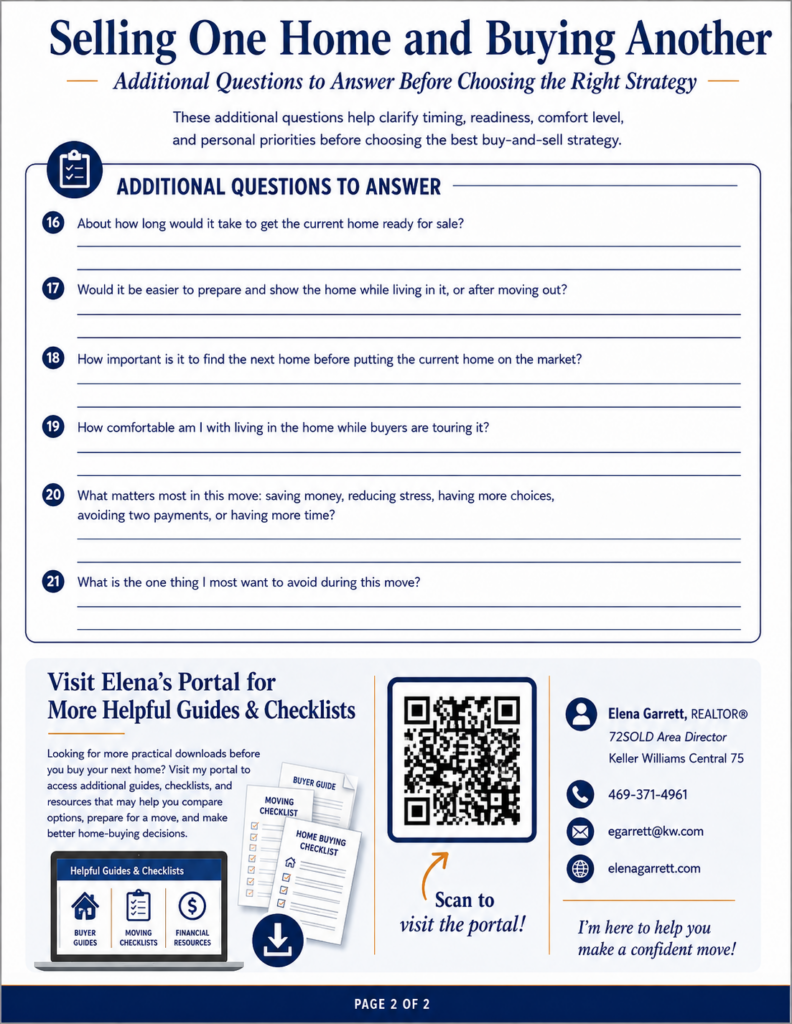
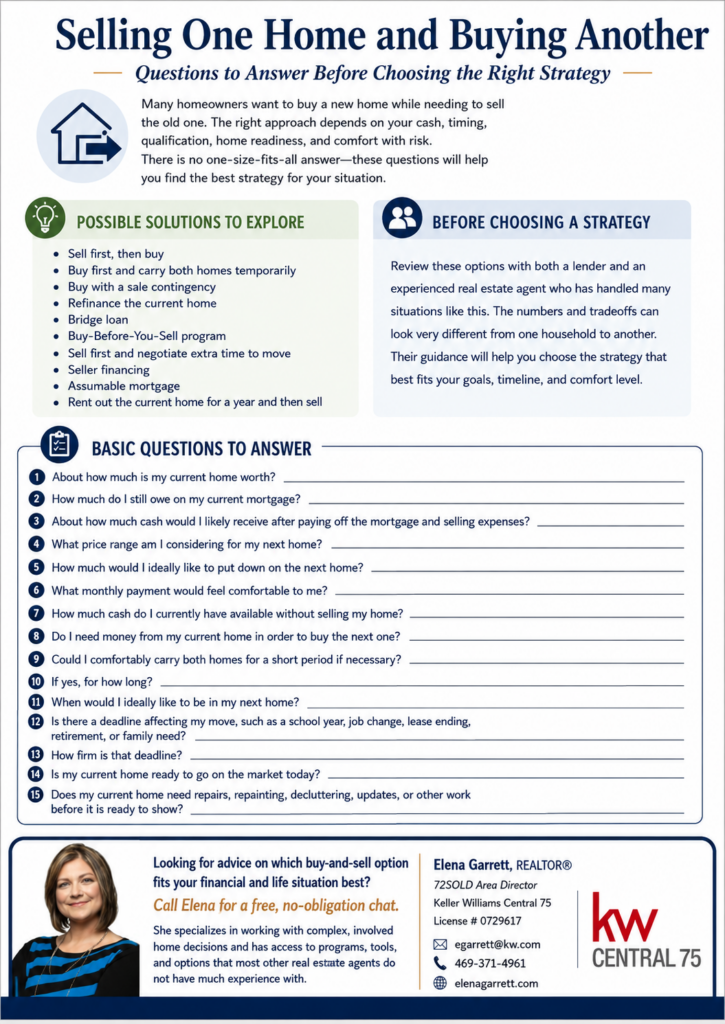
Questions for Sally and Michael to Answer Before Their Next Meeting
1. About how much is their current home worth?
$ ______________________________
2. How much do they still owe on their current mortgage?
$ ______________________________
3. About how much do they think they could actually receive from the sale after paying the mortgage and selling expenses?
$ ______________________________
4. What price range are they considering for their next home?
$ ______________________________
5. How much would they ideally like to put down on the next home?
$ ______________________________
6. What monthly house payment would feel comfortable to them?
$ ______________________________ per month
7. What is their current monthly mortgage payment?
$ ______________________________ per month
8. Could they comfortably make both the old and new house payments for a short period?
Yes / No / Maybe
9. If yes, how long would they be comfortable carrying both homes?
10. How much cash do they currently have available for a down payment without selling their home?
$ ______________________________
11. Do they need the money from the current house in order to buy the next one?
Yes / No / Not sure
12. How important is it to Sally and Michael to find the new house before putting the current one up for sale?
Not important / Somewhat important / Very important
13. How comfortable are they with living in their current home while it is being shown to buyers?
Comfortable / Could tolerate it / Really want to avoid it
14. How worried are they about selling first and then feeling rushed to choose the next house?
Not worried / Somewhat worried / Very worried
15. How important is it for them to be able to make an offer on almost any house they like, rather than only houses whose sellers will accept special conditions?
Not important / Somewhat important / Very important
16. If a solution made moving much easier but cost several thousand dollars, would they consider paying for that convenience?
Yes / No / Depends on the cost
17. What matters most to them: saving money, reducing stress, having more homes to choose from, avoiding two payments, or having more time to move?
18. What is the one thing Sally and Michael most want to avoid during this move?
19. When would they ideally like to be living in their next home?
20. Is there a specific deadline affecting the move?
For example: a job change, school year, lease ending, retirement, new baby, family need, or another important date.
21. If there is a deadline, how firm is it?
Flexible / Prefer to meet it / Must meet it
22. Is their current home ready to put on the market today?
Yes / Almost / No
23. What would they want or need to do before buyers start seeing the house?
Painting, repairs, updating, decluttering, landscaping, cleaning, moving furniture, or other work:
24. About how long do they think it would take to get the house ready for sale?
25. Would Sally and Michael prefer to complete that work while still living in the house, or would it be much easier after they had already moved out?
While living there / After moving out / Either is fine
26. If they had already moved out, would preparing and showing the old house become significantly easier?
Yes / No / Not sure
What had started as a simple question—“Do we have to sell our current home before we buy the next one?”—had turned into a surprisingly complicated decision.
Elena suggested that they meet again, this time at a nearby coffee shop where they could sit down, spread out the numbers, and compare the options one by one. Before they met, though, she wanted Sally and Michael to answer the questions she had given them so they could work with their actual situation rather than general advice.
In the next few documents, you’ll follow Sally, Michael, and Elena as they examine the different options, run the numbers, and see what each choice would actually mean for them.