
You Got a Cash Offer. But What Does That Actually Mean?
September 20, 2026
by Elena Garrett, Realtor – Aug 2026
You Got a Cash Offer. But What Does That Actually Mean?
Suppose a homeowner receives a cash offer of $310,000 for their house.
How much do you think that homeowner is going to get once everything is said and done?
If your immediate answer was “somewhere close to $310,000, give or take”, you just made the same mental shortcut that many homeowners make when they receive a cash offer.
In this article, we are going to look at what that $310,000 cash offer actually means — and what it does not.
We will look at why the number on the offer is not necessarily the number the seller ultimately receives, what the word cash really means when the person making the offer may not personally have $310,000 to pay you, and how the roles of the people involved can affect whether you actually get the money you were expecting.
Most importantly, we will look at the early clues that can tell you when a seemingly simple cash offer may be heading in a very different direction.
Because sometimes the red flags are there from the beginning.
You just have to know what you are looking at.
Meet Sherry
Sherry owned a three-bedroom, two-and-a-half-bath house that had developed far more problems than she could afford to fix.
This was not a house with one or two cosmetic issues.
One of the bathrooms had been shut off from the water entirely because it was unsafe to use. Another bathroom was technically still usable, but it was leaking. The dishwasher was leaking into the cabinets, creating the smell of wet wood and rot. Mice had chewed through the pantry, leaving droppings and damaging food and other items. Sherry tried to block the opening with steel wool, but the mice kept getting back in.
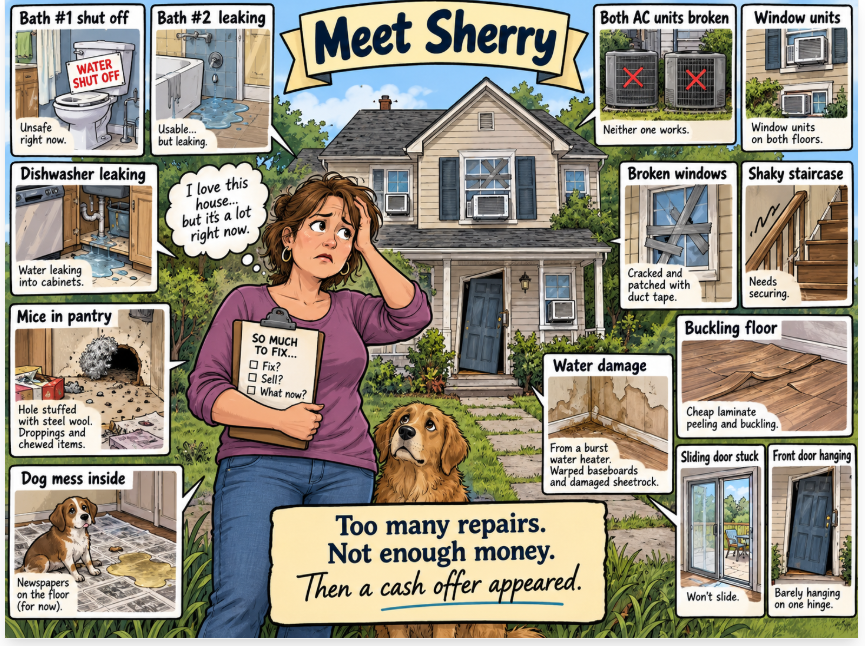
Neither of the home’s two air-conditioning units worked, so Sherry was relying on window units on each floor. The staircase shook and needed to be secured, but she did not have the money to do it. The cheap laminate flooring was peeling and buckling. After the water heater burst, insurance replaced the heater itself, but the house was still left with water damage, warped baseboards, and damaged sheetrock.
There were also everyday quality-of-life issues that made the house even harder to live in and harder to sell. Dogs were using the house as a bathroom, with poop and pee on newspapers inside. The sliding door would not slide. The front door was barely hanging on one hinge. Several windows were broken and patched with duct tape.
In short, Sherry had a house with too many problems, not enough money, and no realistic way to bring it up to market-ready condition anytime soon.
So when somebody came along offering cash, that got her attention.
Meet Elena
I had known Sherry for a while before she was ready to sell. Over time, I had talked with her about the house, the condition it was in, and what selling it would realistically involve.
Eventually, she asked me to price it.
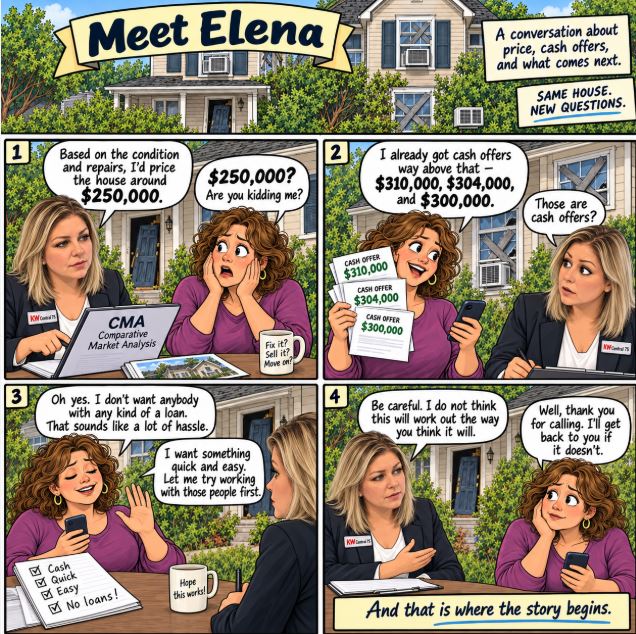
At the time, fully remodeled homes in her neighborhood were selling roughly in the $340,000 to $380,000 range, depending on size and features. Homes that were not remodeled but were still reasonably move-in ready were selling closer to $300,000. Sherry’s house was neither remodeled nor move-in ready. Once I looked at the amount of work that would be needed just to bring the property to a condition where a typical FHA, VA, or conventional buyer could realistically finance it, I recommended pricing it around $250,000.
Sherry looked at me like I had lost my mind.
Sherry: “Two hundred and fifty thousand? Are you kidding me?” Elena: “No. Why?”
Sherry: “Because I already have multiple cash offers way above that.” That got my attention. Elena: “How much?”
Sherry: “The one I like is $310,000. I also have one for $304,000 and another for $300,000.”
Elena: “Those are cash offers?” Sherry: “Oh, yes. And honestly, I don’t want anybody with any kind of a loan. That sounds like a lot of hassle. I want something quick and easy.” She thanked me for calling and told me she wanted to try working things out with the cash buyers first.
I warned her to be careful. Elena: “I really don’t think this is going to work out the way you think it will.”
Sherry was not convinced. Sherry: “Well, then I’ll get back to you if it doesn’t.”
And that is where the story begins.
Misconception #1: “I Signed a Contract, So I Sold the House”
About a month later, I called Sherry to see how things were going with the cash offers.
Elena: “So, how is it going?” Sherry: “Great. I sold the house.” Elena: “Congratulations! You already got the money?” Sherry: “Oh no, not yet.” Elena: “Did you close?” Sherry: “No. I don’t think so.”
Elena: “Then you haven’t sold the house yet. You signed a contract that may lead to a sale. That is not the same thing as a completed sale.”
Sherry was not interested in the distinction. Sherry: “Well, as far as I’m concerned, I sold the house.”
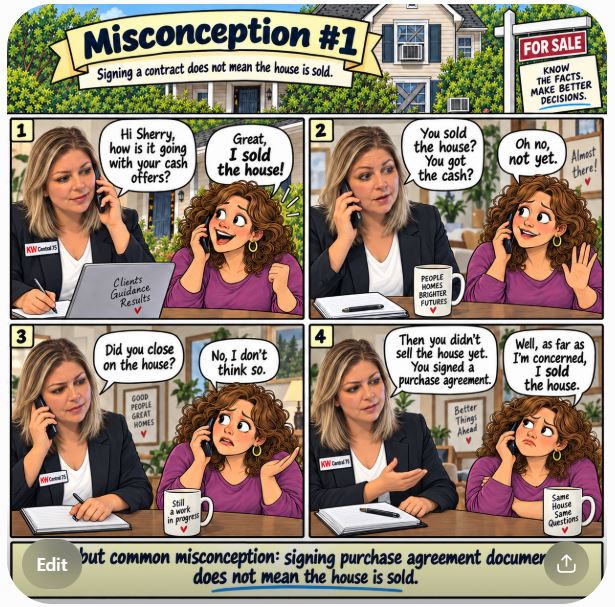
And this was the first major misunderstanding. A signed purchase contract is an important step, but it is still only a step. The buyer has not necessarily met all the contract conditions. The buyer has not delivered the $310,000 to the title company escrow account. The title company has not necessarily closed the transaction. The money has not necessarily been funded. Ownership has not necessarily transferred.
Until those things happen, the seller has a contract to sell the house, not the proceeds from a completed sale. That distinction may sound technical when everything is going well. It becomes much more important when things start going wrong.
Who Is Jake? And Why Is He Not Returning Sherry’s Texts? And Why Are There People Banging On Sherry’s Door?
At that point, Sherry still was not very interested in my distinction between “I signed a contract” and “I sold the house.” As far as she was concerned, the house was sold. But then she added something that got my attention.
Sherry: “The only problem is, for the last week or so, all kinds of people have been banging on my door. Is that something I should be concerned about? I don’t open. I live alone.”
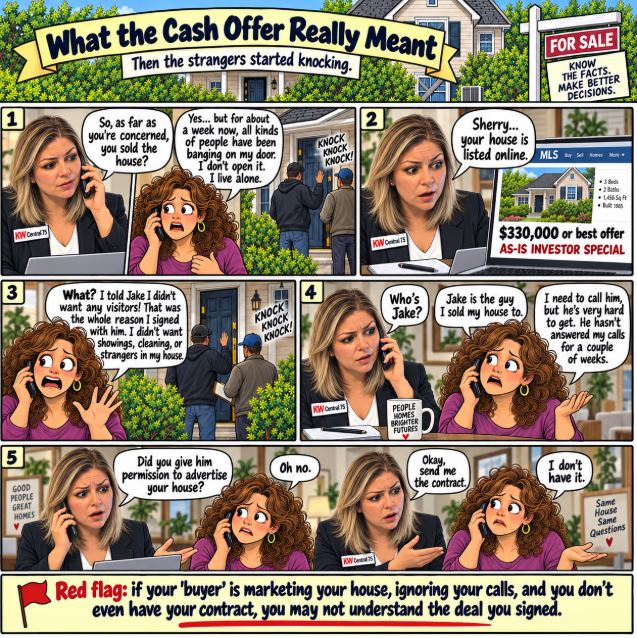
I immediately pulled up the MLS information and checked her address. Sure enough, there it was. Her house was being advertised online for $330,000, marked “or best offer,” “as is,” and described as an investor special.
Elena: “Oh — so you have an active listing?” She sounded confused. Sherry: “What? I told Jake I didn’t want any visitors. That was the whole reason I signed with him.”
Elena: “Who’s Jake?” Sherry: “Jake is the guy I sold my house to.” Elena: “And you told him you didn’t want people coming through the house?” Sherry: “Yes. I specifically told Jake the reason I wanted a cash offer was so I wouldn’t have to do showings, clean the house, or have strangers walking through my house.” Elena: “Well, as of right now, your house is being advertised online, and the people banging on your door are probably trying to see it.”
Sherry was upset. Sherry: “Well, I need to call Jake and straighten this out.” Then she added something even more troubling. Sherry: “The only problem is, he’s very hard to get ahold of.”
Elena: “What do you mean?” Sherry: “He hasn’t really been answering my calls for a couple of weeks now.”
At that point I asked the next obvious question. Elena: “Did you give him permission to advertise your house?” Sherry: “Oh, no, that is why I wanted to sell cash, so it would not be online. I don’t want strangers in my house.”
Elena: “Is there something in the contract that allows him to list the house in the MLS?” Sherry: “I don’t know. I think so.” Elena: “Okay. Send me the contract.” Sherry: “Well… I don’t have it.”
Why This Was a Serious Red Flag
Sherry believed she had sold her house to Jake for cash. Yet her house was being marketed to other buyers at a higher price, strangers were showing up at her door, Jake had stopped returning her calls, and Sherry did not even have a copy of the agreement she had signed.
At that point, the question was no longer simply: “How much did Jake offer?” The more important question became: “What exactly did Sherry agree to — and what was Jake actually doing with that agreement?”
Sherry Did Not Even Have the Copy of the Sale Contract
At that point, I was already concerned. Her house was being advertised online without her knowledge or permission. Strangers were banging on her door. Jake was not returning her calls. And now Sherry was telling me she did not even have a copy of the contract she had supposedly signed.
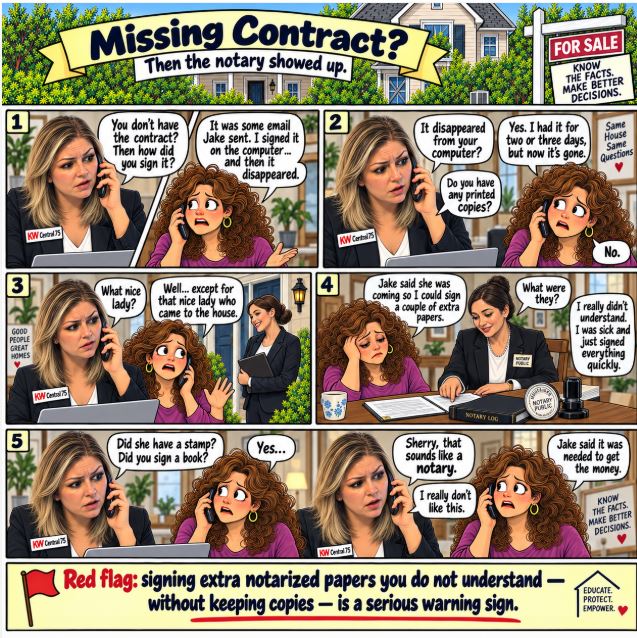
Elena: “You don’t have the contract? Then how did you sign it?” Sherry: “It was some email he sent me. I signed everything on the computer. But after a couple of days, it disappeared.”
Elena: “It disappeared from your computer?” Sherry: “Yes. I had it for two or three days, and now it’s gone. Elena: “Did you print anything? Do you have any physical copies?” Sherry: “No.”
Then she added something that made the story even stranger.
Sherry: “Well… except for that nice lady who came to the house.” Elena: “What nice lady?” Sherry: “Jake said somebody would be coming by and that I needed to sign a couple of additional papers.”
That stopped me.
Elena: “Wait. A lady came to your house, and you physically signed papers for her?” Sherry: “Yes.” Elena: “How many?” Sherry: “Just a couple.” Elena: “What were they?”
Sherry had no real answer.
Sherry: “I didn’t really understand. I wasn’t feeling well that week. And the day she came over, I had very bad stomach pains. She was very nice and polite, but honestly, all I wanted was for her to leave so I could lie down. So I just signed everything quickly.”
Elena: “Did she have a stamp with her?” Sherry: “Yes. A little stamp.” Elena: “Did you have to sign a book too?” Sherry: “Yes. Some book.”
Now it clicked.
Elena: “Sherry… it sounds like a notary came to your house.” Sherry: “Oh yes, Jake said there was going to be a notary coming, yes.”
That bothered me immediately. A seller not understanding the purchase contract is one problem. A seller signing additional notarized documents, while sick, without understanding what they are, is a much bigger problem. So I asked the question that was now running through my mind.
Elena: “Why would you need a notary for this?” Sherry: “I have no idea. Jake said it was needed for me to get the money.”
Why This Was a Serious Red Flag
At this point, the issue was no longer just that Sherry was confused. The issue was that she had:
- signed documents she did not understand,
- failed to keep copies of what she signed,
- allowed a notary to witness additional paperwork,
- and still could not clearly explain what any of those extra documents were supposed to do.
That is how people can end up agreeing to far more than they realize. A homeowner may think they are simply signing papers “to get the money,” when in reality they may be signing documents that affect control of the property, the ability to market it, or other rights they did not intend to give away.
And Sherry still believed she had done something simple: she thought she had sold her house for cash. What she actually had was a pile of unanswered questions.
Mike, Red Robin LLC, and a House Listed from Iowa
Sherry was still sitting across from me at the kitchen table when she mentioned something else.
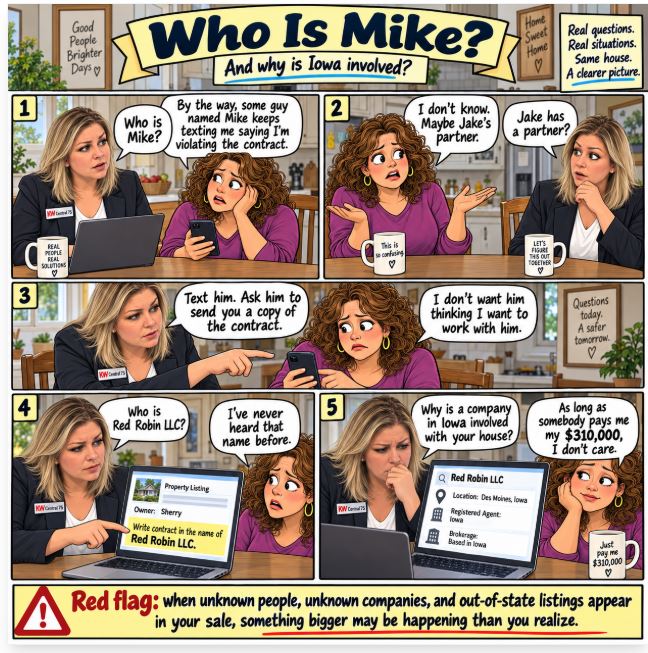
Sherry: “By the way, some guy named Mike keeps texting me saying I’m violating the contract.”
I stopped what I was doing. Elena: “Who is Mike?” Sherry: “I don’t know. Maybe Jake’s partner.” Elena: “Jake has a partner?”
Sherry shrugged. She had been deleting Mike’s messages because she did not understand them and did not want him to think she was interested in dealing with him.
I told her not to delete the next one. Elena: “Text him. Ask him to send you a copy of the contract.” She did not want to. Sherry: “I don’t want him thinking I want to work with him.” Elena: “Forget that for a minute. We need to see what you signed.”
While we waited, I pulled up the online advertisement for the house again and started reading it more carefully. The owner in the tax records was listed as Sherry. But the instructions said that any offer should be ignore the tax records information and instead use the name of Red Robin LLC as the house owner.
I turned the laptop toward her. Elena: “Who is Red Robin LLC?” Sherry: “I have no idea.” Elena: “Is that Jake’s company?” Sherry: “I’ve never heard that name before.”
So I looked it up. The company appeared to be a small wholesaling business in Iowa. Then I looked at the brokerage advertising the house. A real estate brokerage also from Iowa. I looked back at Sherry.
Elena: “Why is a company in Iowa involved with your house?” Sherry: “I don’t know.”
At this point, Sherry had signed papers she could not find, a man named Jake had stopped returning her calls, another man named Mike was accusing her of violating a contract she did not have, and a company she had never heard of was now appearing as the seller of her house.
Sherry still had the same answer. Sherry: “As long as somebody pays me my $310,000, I don’t care.”
I did. Because by then, I had no idea who was actually controlling this transaction. And neither did Sherry.
Then I Called the Listing Agent for Sherry’s House
At this point, I wanted to know one thing: Who had actually told this brokerage they were allowed to advertise Sherry’s house? So I called the listing agent in Iowa.
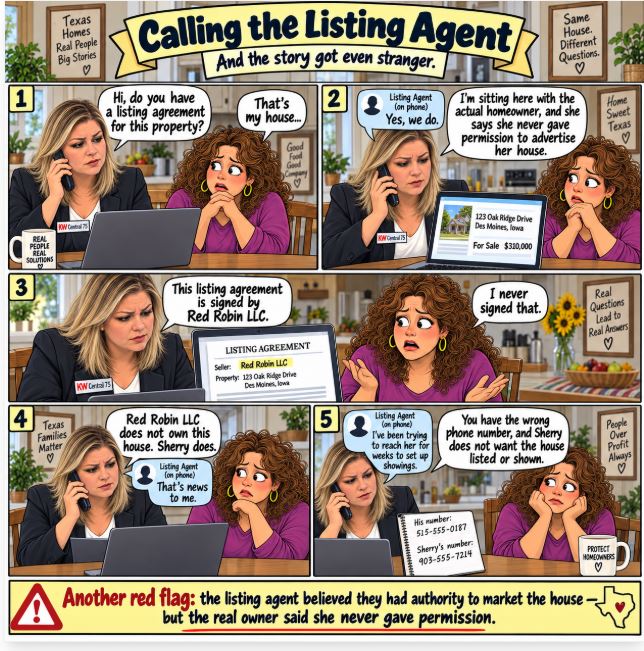
Elena: “Do you have a listing agreement for this property?” Listing Agent: “Yes.” Elena: “I’m sitting in front of the actual homeowner right now, and she says she never gave anybody permission to list or advertise her house. Would you please send me a copy of the listing agreement? I’m her agent.”
A little while later, I was looking at the copy of the listing agreement. And the seller named on the listing agreement was not Sherry. It was Red Robin LLC.
I called the listing agent back. Elena: “Red Robin LLC does not own this house. Sherry does. And Sherry never signed a listing agreement with you.” There was a pause. Listing Agent: “That’s news to me.” Now we had another problem. Elena: “Do you have a phone number for whoever signed the listing agreement?”
Then he asked me something surprising. Listing Agent: “If you’re sitting in front of Sherry, do you have her correct phone number?” Elena: “Yes.” Listing Agent: “Because I’ve been trying for a couple of weeks to reach her to arrange showings.”
We compared numbers. The phone number he had for Sherry was wrong. So while Sherry had been sitting at home wondering why strangers kept appearing at her door, the brokerage had apparently been trying to reach her at a phone number that did not belong to her.
Elena: “At this time, Sherry does not want the house shown, and she does not want it advertised. But before anything else happens, we need to figure out exactly what Red Robin LLC believes it has the right to do.” I asked him to pass my information to the person who had signed the listing agreement. Elena: “Because right now, you have the actual homeowner sitting here saying she does not want this property listed.”
The listing agent sounded genuinely surprised. Listing Agent: “Well, it sounds like she must have signed something giving them permission to advertise it.” Elena: “Do you have a copy of that?” Listing Agent “No.” Another pause. Then he said: “I’ll have somebody call you.”
And once again, Sherry and I were sitting at the kitchen table with more questions than answers. Somebody she had never heard of had signed paperwork to advertise her house. The brokerage believed that company had the authority to do it. The brokerage had been trying to arrange showings with a phone number that was not even Sherry’s. And somewhere, apparently, there was another document that was supposed to explain why all of this was allowed.
Neither Sherry nor I had seen it.
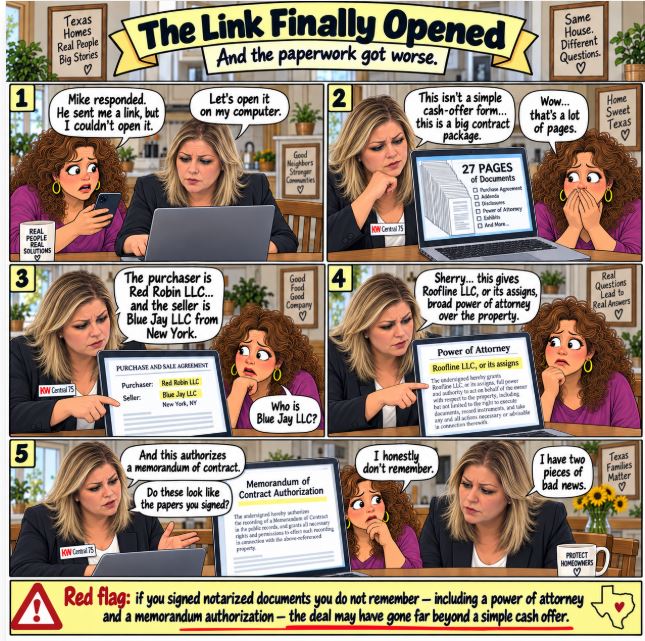
Sherry Finally Gets A Copy Of Her Sale Contract, Plus The Notarized Documents
The next day, Sherry sent me a message. Sherry: “Mike responded. He sent me a link, but I can’t open it.”
So I went back to her house, opened my laptop, and we pulled up the link together. This time, we finally had documents. What appeared on the screen was not a short, simple agreement. It was a stack of scanned papers — roughly 27 pages — and the whole thing looked polished, professional, and very carefully written. It looked like the kind of contract that had been put together by someone who knew exactly what they were doing.
As I started reading, one thing became clear very quickly: This was not a friendly little download-off-the-internet 2-page agreement. This was a serious set of documents, and they were written heavily in favor of the buyer’s side.
Then the names started getting stranger. The purchaser was listed as Red Robin LLC. But the seller was listed as Blue Jay LLC, a company from New York.
Elena: “Who is Blue Jay LLC?” Sherry: “I have no idea.”
So now we had gone from Jake, to Mike, to Red Robin LLC, and now to a completely different company out of New York. Sherry had no idea who any of them were.
And then, buried in the documents, I found exactly what I had been afraid to find. The first document was a power of attorney. It gave Roofline LLC, or its assigns, broad authority to do what they needed to do in order to deal with this property. The second document was an authorization related to filing a memorandum of contract.
I turned the papers toward Sherry. Elena: “Do these look like the papers you signed in front of the notary?” She looked at them for a moment. Then she said the words I was afraid I would hear. Sherry: “I honestly don’t remember what I signed.”
At that point, I looked at her and said: Elena: “I have two pieces of bad news.”
And that is where we will stop for now. Because each of those documents deserves its own explanation.
The First Piece of Bad News: The Power of Attorney
The first document that really worried me was the power of attorney. The document gave Roofline LLC, or its assigns, a long list of powers connected to the sale of Sherry’s property. The list was broad, and it ended with language allowing other reasonable actions needed to secure or complete the sale. What concerned me just as much was what I did not see. There was a beginning date. I could not find an expiration date.
I turned to Sherry. Elena: “Do you know what a power of attorney is?” Sherry: “Yes.” Elena: “When you signed this, did you actually see the words ‘Power of Attorney’?” She looked at the document again. Sherry: “Yes. Now that I see it again, I remember this one.”
That made the next question unavoidable.
Elena: “Then why didn’t you call somebody? Me, an attorney, somebody who understands real estate — and ask what you were giving them permission to do?” Sherry: “I was really sick that week. “
Jake had told her that somebody would be coming to the house with a couple of additional papers that needed to be signed in person. When the notary arrived, Sherry was having severe stomach pain. She told the woman she was not feeling well.
Sherry: “She was very nice. She said it would only take a few minutes. I just wanted her to leave so I could go lie down. So I signed everything.”
The whole visit may have taken five minutes. But now, weeks later, we were sitting at Sherry’s kitchen table trying to figure out what it meant for Sherry’s sale.
I looked at the document again. Elena: “Sherry, this appears to give them very broad authority involving the sale of your property, and I do not see an expiration date. I also do not know, just from looking at this, whether there are restrictions on your ability to revoke it or exactly what would be required to revoke it. But.. Actually, let me take that back. I’m a real estate agent. I’m not an attorney. This is where my advice stops.”
And I was not joking. At that point, Sherry indeed needed a lawyer to read the actual document and tell her exactly what authority she had given away, whether the power of attorney was still effective, and what would be required if she wanted to revoke it. Because now we were dealing with something much more serious than a confusing cash offer. Someone appeared to have written authority, signed by Sherry herself, to take actions involving the sale of her house.
A Very Important Lesson About Powers of Attorney
If somebody involved in buying your house asks you to sign a power of attorney giving them authority over you or your property, do not treat that document like routine transaction paperwork.
Stop. Freeze. Tell the cash buyer you need to review it with an attorney. And indeed, before you sign, have an attorney explain exactly what authority you are giving away, how long that authority lasts, and how it can be revoked. An experienced real estate agent may be able to recognize that the request is unusual and tell you that you need legal advice, but the legal effect of a power of attorney is something an attorney should evaluate.
A power of attorney is a very powerful document because it can allow another person or company to act on your behalf. Depending on how it is written, that authority can affect decisions, documents, and rights connected to your property.
That is why the worst thing you can do is glance at it, assume it is “just another paper needed for the cash sale,” and sign it.
And during a cash-offer transaction, there is one question every homeowner should immediately ask: Why does the person buying my house need the legal authority to act for me?
A buyer already has the right to act for themselves. If they are asking for the right to act for you, that is something very different.
In Sherry’s case, the power of attorney was the first clear sign that this transaction had gone far beyond someone simply agreeing to buy her house for $310,000. And unfortunately, there was still one more notarized document sitting in that stack.

The Second Piece of Bad News: The Memorandum of Contract
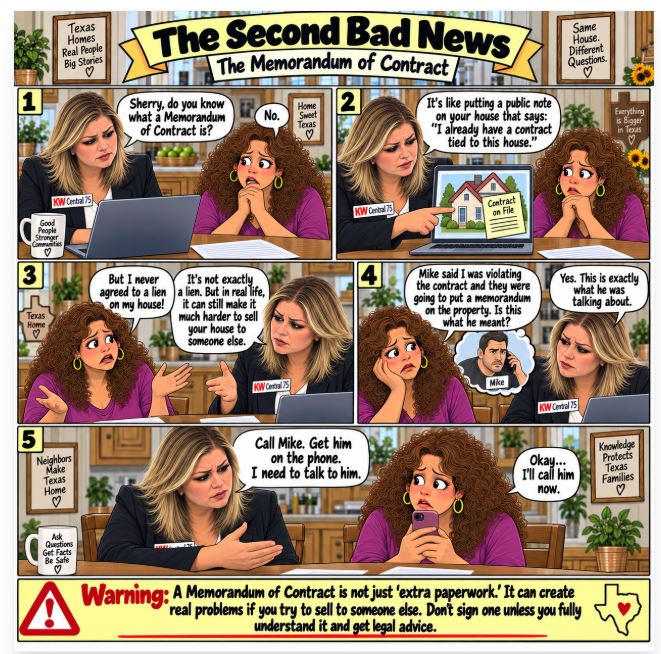
The second notarized document worried me for a different reason. It was an authorization for a Memorandum of Contract.
Elena: “Do you know what a Memorandum of Contract is?” Sherry: “No.”
Elena: “Imagine somebody puts a note in the public county records attached to your house. The note basically says: ‘Before anybody buys this house, you should know that I already have a contract involving this property.’” It does not mean that person owns the house. It is not the same thing as a mortgage lien.
But it can create a very real problem when the homeowner later tries to sell the property to somebody else, because the next buyer and the title company now see another person claiming contractual rights involving the house. In practical terms, that can mean the memorandum may have to be dealt with or released before another sale can move forward cleanly. And very often, the wholesalers ask for money to be paid to release the memorandum.
Sherry: “But I never agreed for them to put a lien on my house.” Elena: “It isn’t technically a lien. But I understand why it feels like one. If you try to sell the house to somebody else and this memorandum is sitting in the county records, the next title company is going to want to know what it is and whether the person claiming those rights has released them.”
That was when Sherry remembered something.
Sherry: “Wait. Mike kept telling me I was violating the contract. He said they were going to put a memorandum on the property. Is this what he was talking about?”
I looked back at the paperwork. Elena: “Yes. This appears to be exactly what he was talking about.”
And there was another important detail. Sherry herself had signed the authorization in front of the notary.
That matters because Texas changed the law effective September 1, 2025, creating new procedures and protections involving a unilateral memorandum of contract — meaning one signed only by somebody who is not the property owner. The statute gives homeowners a process for challenging and releasing those unilateral filings. But Sherry’s situation was different: she had apparently signed the document herself. That meant I was not going to assume those newer protections solved her problem. She needed an attorney to look at the actual paperwork.
At this point, I had had enough guessing. Elena: “Call Mike.” Sherry: “Now?” Elena: “Yes. Get him on the phone and let me talk to him.”
A Warning About Memorandums of Contract
Just like a power of attorney, a Memorandum of Contract is not something I would treat as routine paperwork in a cash-sale transaction. If somebody asks you to sign a document allowing a memorandum to be recorded against your property, stop and find out exactly what it does before signing it.
A memorandum does not transfer ownership of your house, and it is not technically the same thing as a lien. But recording one can put the world on notice that somebody claims contractual rights involving your property. That can complicate a later sale an prevent the title transfer to a new buyer until those claimed rights are resolved.
“Then I’ll Just Cancel It.”
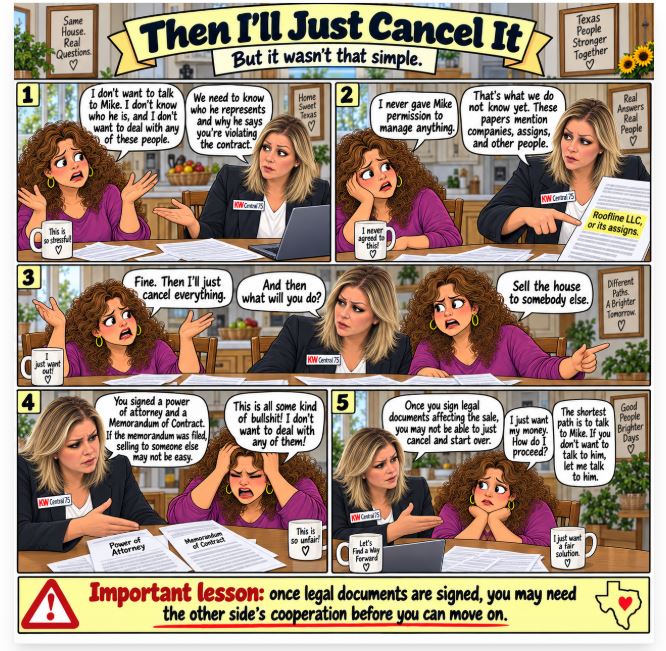
Elena: “Give me Mike’s number, or put him on the phone.” Sherry: “What are you going to tell him?”
Elena: “First, I need to know who he is. Which one of these companies does he work with? Why is he telling you that you’re violating the contract? What does he know about the memorandum? Right now, we don’t even know what role he has in this.”
Sherry shook her head. Sherry: “I don’t want to talk to him. He’s rude when he texts me.” Elena: “At this point, whether you like Mike is almost beside the point. He appears to be involved in this transaction, and we need to understand why.”
She interrupted me. Sherry: “But I don’t even know who he is. I never gave Mike permission to manage anything.”
I pointed back to the documents on the table. Elena: “That is exactly what we do not know yet.” Then I showed her the phrase on the documents: Roofline LLC, or its assigns.
What Does “Or Its Assigns” Mean?
I explained it “or assigns” to Sherry as simply as I could.
Elena: “Imagine you give Roofline a paper that gives Roofline certain rights involving your house. If the agreement allows Roofline to hand that paper to somebody else even without your knowledge or permission, that other person may now be able to step into Roofline’s place. That is what an assignment is. One person or company has rights under a contract, and the “assignment” right allow those rights to be transferred to somebody else.”
I could tell Sherry exactly which rights had legally transferred to Mike, Red Robin LLC, or anybody else. We had several different documents in front of us, including a power of attorney, and I was not going to pretend I could give her a legal interpretation of all of them.
But it did mean something important: Sherry could no longer assume that Jake was the only person she had to deal with simply because Jake was the person she originally met.
Elena: “You signed documents that mention other companies and possible assigns. So when somebody like Mike appears and says he has rights under your contract, we cannot just say, ‘I don’t know you, go away.’ We first have to find out whether the documents you signed gave him, or the company he represents, some legal role.”
Sherry had a much simpler solution. Sherry: “Fine. Then I’ll just cancel everything.” Elena: “Cancel what?” Sherry: “This whole sale thing. I don’t want to deal with these people anymore.”
And this is where we reached another misunderstanding that I think many homeowners would have.
“It’s My House. Why Can’t I Just Cancel?”
Sherry genuinely believed that because she still owned the property, she could simply announce that the transaction was over.
Sherry: “I’m the owner. If I don’t want to sell it to them anymore, I’ll cancel.” Elena: “Being the owner does not mean you can ignore a contract you voluntarily signed.”
I pointed to the stack of approximately 27 pages. Elena: “Somewhere in here are the rules you and the other side agreed to. There may be ways for you to terminate. There may be deadlines. There may be things the other side has to do and things you have to do. But we have to find those rights in the agreement. You don’t automatically get a ‘never mind’ button because you changed your mind.”
Sherry: “But it’s still my house.” Elena: “Yes. You still own your house. But you also signed an agreement concerning what you can do with it – without violating that agreement. The document you signed looks like it was prepared by an attorney for situations just like that. I am pretty sure it will not be written in your favor. And now that you signed it, you have to abide by it, while it is in force.”
Sherry: “But I didn’t realize they would start doing all of these things when I was signing it! They broke their word, so I can break mine!” Elena: “I recommend talking to an attorney to help you to understand this 27 page contract first. I would not just assume that the whole thing will just go away just because you changed your mind about working with them.” Sherry: “How much would an attorney cost? I do not have money to hire an attorney! It is easier for me to just stop talking to them, maybe they will just leave me alone.”
Why “I’ll Just Cancel” May Not Work
A seller usually cannot simply walk away from a signed purchase agreement because the seller no longer likes the transaction. Whether the seller has a right to terminate depends on the actual contract, the circumstances, and applicable law. Sometimes there is a contractual way out. Sometimes the other side has breached the agreement. Sometimes both sides voluntarily agree to terminate.
And sometimes the seller may be bound unless a lawyer finds another legal basis for ending it.
By this point we were dealing with powers of attorney, assignments, a memorandum of contract, multiple companies, and a contract written heavily in favor of the purchaser. This had moved well beyond ordinary real estate guidance. Sherry needed legal advice.
“But Jake Told Me He Was the Cash Buyer”
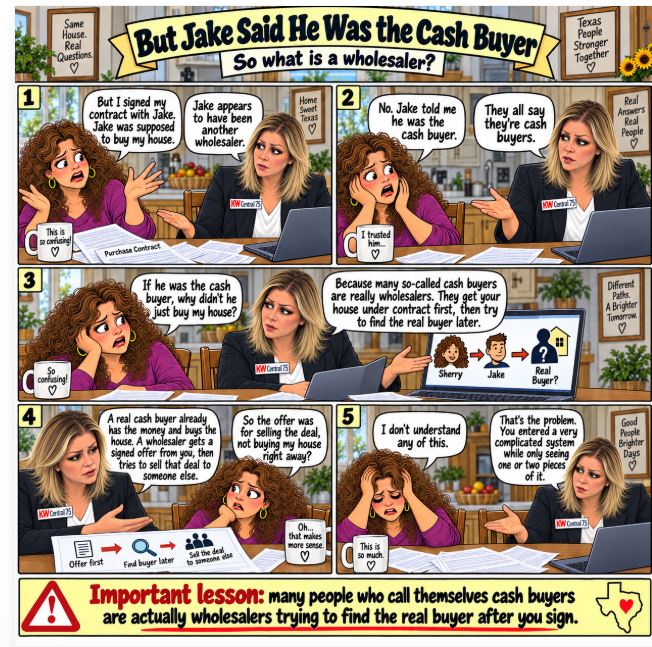
Sherry: “Look, for all I know, I signed my contract with Jake and that is it. Jake was supposed to buy my house.” Elena: “They all say that they are cash buyers because “cash buyer” is the concept you understand. But no, based on what I see, Jake appears to have been simply a wholesaler.”
Sherry: “No. Jake told me he was the cash buyer. He never said anything about being a wholesaler. Why can’t he just buy my house and all of this be over with?” Elena: “Because that does not appear to be his business model! He wants to flip contracts, not houses. See, he caught you in his net exactly because he used the words “cash buyer” were you “trigger words” to keep you talking to him. But the words cash buyer are just a shiny object, something that you believe in and you follow this shiny object like a puppy, but they may or may not necessarily be true in his case.” Sherry: “So, he lied to me?” Elena: “I do not know for a fact, but so far, if he wanted to buy your house with cash, he would have by now.”
And suddenly we were back at the very first misunderstanding in this story. I tried to make it as simple as possible.
Elena: “See, Sherry, there are investors who do actually intend to buy properties in the DFW. With cash or with hard money loans, that is a different story, but they are the true end users, so to speak. Lets call them “flippers” for the time being. But they will rarely be the ones talking to people like you for months on the phone. They are too busy for work like that – that is not where their skills are, anyway. They are skilled at updating homes, not at talking on the phone.
And then there are people like Jake, and, apparently, Roofline and the rest, whose entire cottage industry of people whose whole craft is finding distressed houses, taking to people on the phone for months, making the homeowners believe that they are “cash buyers,” getting the homeowners under contract, and then trying to sell those contracts to “flippers” who actually want to buy them. They may know nothing about updating homes, and actually flipping homes may NOT be their skillset.
Those people may call themselves wholesalers, acquisition people, deal finders, or sometimes other names. And they do market to homeowners using the phrase cash buyer because the ads for cash buyers generate a lot of leads for them. That does not necessarily mean the person standing in your kitchen has $310,000 sitting in a bank account waiting to buy your house. Sometimes it means: “If believe I can find some flipper who will pay more than $310,000 for this house.”
Sherry: “I feel so angry at Jake! He sure had me fooled! And what a mess he made! If he told me he was a wholesaler, I wouldn’t have dealt with him.” Elena: “That is exactly why Jake did NOT tell you about his true role.”
Sherry: “Then why did Jake give me an offer if he didn’t have the $310,000?” Elena: “Again, because he most likely does not have $310,000, however, having you to sign the offer at $310,000 gave him something valuable that he could take to other investors to get paid a finder fee.”
That was the part she could not get her head around. Jake did not necessarily need to have $310,000 first. He only needed Sherry to agree to $310,000 first. Then he could take that agreement and see whether another investor thought the numbers worked. If somebody did, the transaction could move forward. If nobody did, that was when the problems could begin.
Sherry shook her head. Sherry: “I don’t understand any of this.” And that, unfortunately, was exactly the problem.
She had entered a transaction believing there were only two people and two numbers: Sherry. Jake. $310,000.
But behind those three simple things were companies, contracts, assignments, other investors, powers of attorney, a memorandum, and people Sherry had never heard of. She had been making decisions based on two or three pieces of information. The transaction was operating on many more. And that brings us right back to the question at the beginning of this article:
If somebody gives you a $310,000 cash offer, does that mean you are going to receive $310,000?
Not necessarily. Before you can answer that question, you first have to understand who actually intends to buy the house, what still has to happen before closing, and what the person giving you that offer is really promising to do.
And Then, There is The Daisy Chain Of People Wanting To Get Paid
Sherry was still trying to make sense of all the names.
Sherry: “So if Jake wasn’t really the cash buyer, then who are all these other people?” Elena: “More wholesalers.” Sherry: “But why would they buy something from Jake if Jake doesn’t own my house?” Elena: “They didn’t buy your house from Jake. They bought his place in the contract.” Sherry: “What does that mean?”
I tried to make it as simple as possible.
Elena: “Imagine Jake’s name is written on a coupon that says, ‘I have the right to buy Sherry’s house for $310,000.’ Jake does not own your house, so he cannot sell your house. But if the contract allows him to assign it, he may be able to pass that coupon to somebody else and put their name where his used to be. Let’s say Jake wants $5,000 for finding the deal. He offers that $310,000 contract to Roofline for $315,000, and if Roofline takes it, Jake keeps the $5,000 as his assignment fee once the house finally sells and there is a closing.”
Sherry: “What? Jake wants to make $5,000? Off my house? How dare he!!! And without even telling me! But… Why would Roofline pay $315,000 for something Jake got for $310,000?” Elena: “Because, first, Roofline may not know exactly what Jake is making. And second, Roofline may believe it can pass that contract to somebody else for even more. Maybe Roofline thinks it can find somebody willing to take it for $319,000 and keep another $4,000 for itself.”
That appeared to be roughly what had happened here. Jake appears to have passed the contract to Roofline LLC. Roofline may have passed it to Blue Jay, possibly adding another fee, and there may have been other people in between. Blue Jay then appears to have passed it to Red Robin LLC. If Red Robin could not find the final buyer, Red Robin could potentially try to pass it again.
Sherry: “To who? And for how much? If somebody is willing to pay $319,000, I want my house to sell for $319,000 to THAT person!” Elena: “That’s the problem. We don’t know who else might receive the contract next, and we don’t know what numbers are being discussed between those people.”
She thought about that for a moment.
Sherry: “Can any of these people actually buy my house for $319,000 or more? Because I would like that.” Elena: “If one of them actually wanted to own the house at those numbers, we probably would not still be sitting here trying to figure out who the real buyer is. And even if the final person pays $319,000, that does not mean you receive $319,000. The people in the middle may already be expecting to get paid for passing the contract along.”
Sherry: “So Jake gets paid. Roofline gets paid. Maybe Blue Jay gets paid. Red Robin wants to get paid. And I’m the one who owns the house?” Elena: “Exactly. Their fees may be built into the amount the final buyer has to pay, but that does not mean that extra money belongs to you.”
That led Sherry to the most obvious question.
Sherry: “Then why can’t Jake just find somebody to buy the house for $310,000 and be done with it?” Elena: “Because the investors who actually have the money and actually want to own a house like yours may not believe it is worth $310,000 to them. If somebody who truly wanted the house thought $310,000 worked, there probably would have been a closing by now. Instead, Jake seems to keep finding only other wholesalers.”
Sherry: “Why wouldn’t a real investor pay $310,000? It got great bones, and you know how good this location is!” Elena: “Because, as I told you in the beginning, the math probably doesn’t work.” Sherry: “What math?”
And that is a whole different explanation.

Homeowner’s Math Meets Investor’s Math
“But the Math Does Work!”
Sherry looked flustered. Sherry: “Wait a minute. One of the houses in this neighborhood sold for $375,000. You’re saying mine might need around $60,000 in repairs. So $375,000 minus $60,000 is $315,000. Jake offered me $310,000. That means he’s getting a great deal.”
I understood exactly what she had done. Elena: “First of all, that assumes that once this home is repaired, it can sell AND appraise for the same price as the highest sold home in the area. That is a big gamble. But second of all, no. This calculation is what I call “homeowner math.”
Sherry: “Homeowner math?” Elena: “Yes. Homeowners usually look at a house project like this: Price + Repairs = Value. You’re thinking that if he pays $310,000 for the house and spends $60,000 fixing it, he has $370,000 invested in a house worth $375,000.”
Sherry: “Exactly.” Elena: “And that is the problem.” She looked at me like I had misplaced a calculator.
Sherry: “Why? He still makes $5,000. I know it is not a lot, but it is a very nice house!”
Elena: “No he does not make $5,000. In fact, he is seriously upside down.” Sherry: “How come?”
Elena: “It is a long story, but…. An investor does not just have the purchase price and the repair bill and he is good to go. The investor has to buy the property. There may be title costs, loan fees, closing costs, inspections, and other acquisition expenses. Then someone has to pay for the money itself. If the investor borrowed it, there may be interest and lender fees. If the investor used their own cash, that money is still tied up in the property while the project is underway.
And let’s not forget the assignment fees for the Jakes and Red Robin, and Blue Jay, and Roofline, and whoever else might be a part of that daisy chain.
Meanwhile, the house keeps costing money. There may be property taxes, insurance, utilities, lawn care, security, permits, contractors, dumpsters, and all kinds of little expenses that seem to reproduce when nobody is looking.
Then there is the biggest wildcard of all: the repairs themselves. A $60,000 renovation estimate does not come with a force field. Once walls start opening, investors can discover previously undetected plumbing problems, electrical problems, rotten wood, foundation issues, HVAC surprises, city or safety compliance issues, or something else nobody saw during the original walkthrough.
And finally, after doing all of that work, the investor still has to sell the house. Selling can mean paying real estate commissions (for the buyer and for the seller side), paying more title expenses, buyer concessions, another round of repairs after an inspection, financing delays, appraisal problems, and the possibility that the house does not sell for quite as much as everyone hoped.
So the investor’s formula looks very different.
Homeowner Math: Purchase Price + Repairs = Offer Price
That is essentially the calculation Sherry had made.
Investor Math: Purchase Price + Assignment Fees + Repairs + Buying Costs + Holding Costs + Selling Costs + Profit = Offer Price
That final part— profit — matters more than a homeowner can usually understand. The investor is not buying a damaged house, spending 3-4 months managing contractors, putting in his physical labor, risking hundreds of thousands of dollars, carrying the property for months, dealing with city permits and daily chaos of the flip projects, and then selling it again just to hopefully make $5,000. At that projected income for 3-4 months worth of work, he could as well work as a Walmart cashier! There has to be enough room in the numbers for the project to make financial sense.

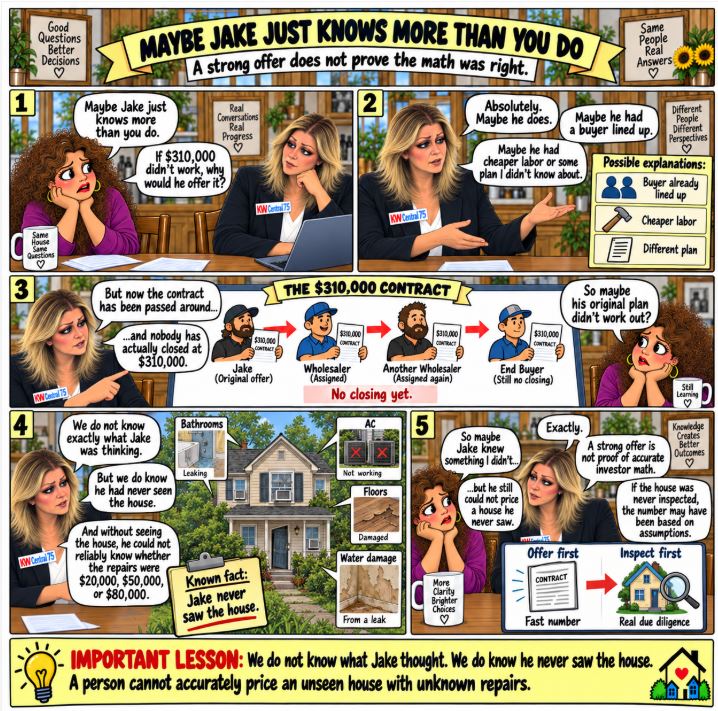
“Maybe Jake Just Knows More Than You Do”
Sherry was still not convinced.
Sherry: “Well, for whatever reason, Jake thought $310,000 was a good number. Maybe he just knows more about this than you do. After all, he’s an investor and you’re not.” Elena: “Absolutely. Maybe he does.”
She looked surprised.
Elena: “I’m serious. Maybe Jake had a buyer already lined up. Maybe somebody wanted the house for themselves and didn’t need normal investor margins. Maybe he had unusually cheap labor. Maybe he had some plan that made $310,000 work. And for the first few days of you signing the offer with him, I would be perfectly willing to leave that possibility open. But now we know something we didn’t know then. The contract has been passed through several people, the property has been marketed around, and nobody has actually shown up and closed at $310,000.”
That didn’t prove Jake had been wrong. But it certainly made me less confident that whatever he originally planned had actually worked.
Elena: “Maybe he underestimated the repairs. Maybe he overestimated the resale value. Maybe the buyer he expected disappeared. Maybe he thought the contract would be easy to assign and then discovered that the people with the actual money didn’t like the deal.” Sherry: “But we don’t really know.” Elena: “Correct. We don’t know what Jake was thinking. But there is one thing we do know.” Sherry: “What?” Elena: “Jake had never seen your house.”
That was the part I kept coming back to.
Elena: “He didn’t know whether this was a $20,000 repair job, a $50,000 repair job, or an $120,000 repair job. He had never walked through the bathrooms, looked at the flooring, checked the AC systems, seen the water damage, or really evaluated the condition.”
Sherry thought about that. Elena: “Did you ever ask him how he came up with $310,000?” Sherry: “No. But I thought it made good sense since I had some repairs to do.”
Elena: “I would each investor you talk to to explain their numbers to you. Why $310,000? Why not $285,000? Why not $325,000? What was the calculation behind the number?”
There was only one problem. By this point, Sherry could not get Jake to communicate with her. So whatever his original plan had been, we could only guess.
Elena: “Maybe Jake knew something I didn’t. That’s possible. But even if he understood investor math perfectly, he still couldn’t accurately estimate the condition of a house he had never seen.”
And that brought us straight to Sherry’s next objection.
“I Don’t Want People Coming Through My House”
Sherry: “So, investors want to come with contractors? No, I do not want people coming through my house.” Elena: “I know. And that is completely your choice. Just understand that the price of privacy is uncertainty in the outcome.” Sherry: “What do you mean?”
Elena: “You may already have the real investors trying to get in. Those may be some of the people who have been calling and knocking on the door. They actually want to see the property because they are trying to decide whether they are willing to put their own money into it.” Sherry: “But that is exactly what I don’t want. I don’t want people walking through here looking at everything. The house is a mess and I… I just don’t like people coming over.”
Elena: “Then you have to accept that you may not get a firm, dependable number from a sight-unseen offer and than your offer could get re-adjusted down significantly even after you signed the offer. Unless you home was priced so low to start with, the repairs would be irrelevant. But this is not the case here. If you want certainty, you have to remove the obstacle for the people who can actually HAVE the cash. A true investor who has a true desire to pick up a project generally does not want to buy an unknown item. They want to inspect it, understand it, calculate the repairs and then decide what they can really pay.”
Sherry: “And if I don’t let them?”
Elena: “Then the wholesalers like Jake 1, Jake 2, Jake 3 and so on can keep doing what they have been doing: passing the contract from one person to another while everybody is trying to find the investor who will finally accept the deal.”
Elena: “So there really is a choice here. You can protect your privacy very tightly, but the price of that privacy is uncertainty. Or you can give serious investors controlled access to the property and get much closer to a real number much earlier.”