
You Got a Cash Offer. But What Does That Actually Mean?
September 20, 2026
by Elena Garrett, Realtor – Aug 2026
You Got a Cash Offer. But What Does That Actually Mean?
Suppose a homeowner receives a cash offer of $310,000 for their house.
How much do you think that homeowner is going to get once everything is said and done?
If your immediate answer was “somewhere close to $310,000, give or take”, you just made the same mental shortcut that many homeowners make when they receive a cash offer.
In this article, we are going to look at what that $310,000 cash offer actually means — and what it does not.
We will look at why the number on the offer is not necessarily the number the seller ultimately receives, what the word cash really means when the person making the offer may not personally have $310,000 to pay you, and how the roles of the people involved can affect whether you actually get the money you were expecting.
Most importantly, we will look at the early clues that can tell you when a seemingly simple cash offer may be heading in a very different direction.
Because sometimes the red flags are there from the beginning.
You just have to know what you are looking at.
Meet Sherry
Sherry owned a three-bedroom, two-and-a-half-bath house that had developed far more problems than she could afford to fix.
This was not a house with one or two cosmetic issues.
One of the bathrooms had been shut off from the water entirely because it was unsafe to use. Another bathroom was technically still usable, but it was leaking. The dishwasher was leaking into the cabinets, creating the smell of wet wood and rot. Mice had chewed through the pantry, leaving droppings and damaging food and other items. Sherry tried to block the opening with steel wool, but the mice kept getting back in.
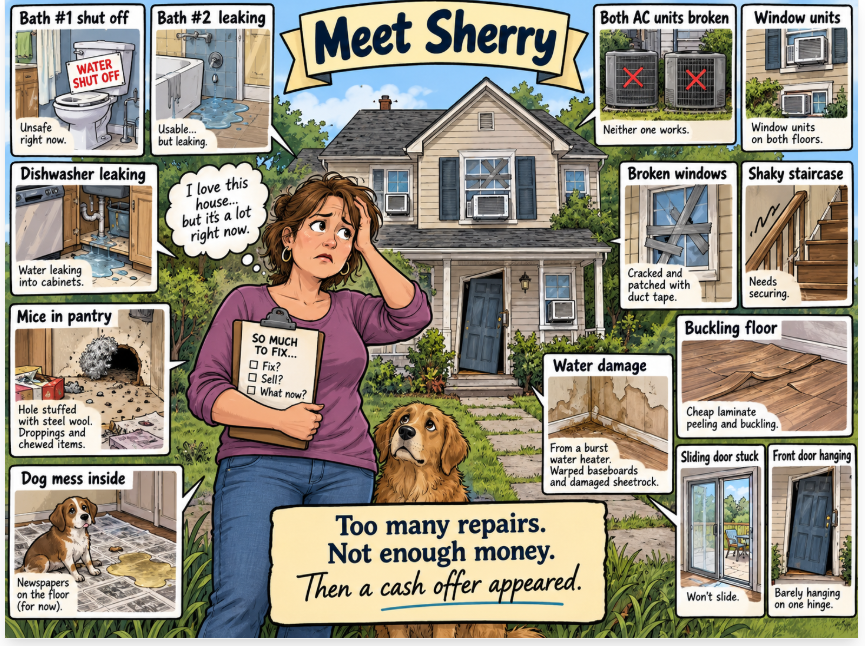
Neither of the home’s two air-conditioning units worked, so Sherry was relying on window units on each floor. The staircase shook and needed to be secured, but she did not have the money to do it. The cheap laminate flooring was peeling and buckling. After the water heater burst, insurance replaced the heater itself, but the house was still left with water damage, warped baseboards, and damaged sheetrock.
There were also everyday quality-of-life issues that made the house even harder to live in and harder to sell. Dogs were using the house as a bathroom, with poop and pee on newspapers inside. The sliding door would not slide. The front door was barely hanging on one hinge. Several windows were broken and patched with duct tape.
In short, Sherry had a house with too many problems, not enough money, and no realistic way to bring it up to market-ready condition anytime soon.
So when somebody came along offering cash, that got her attention.
Meet Elena
I had known Sherry for a while before she was ready to sell. Over time, I had talked with her about the house, the condition it was in, and what selling it would realistically involve.
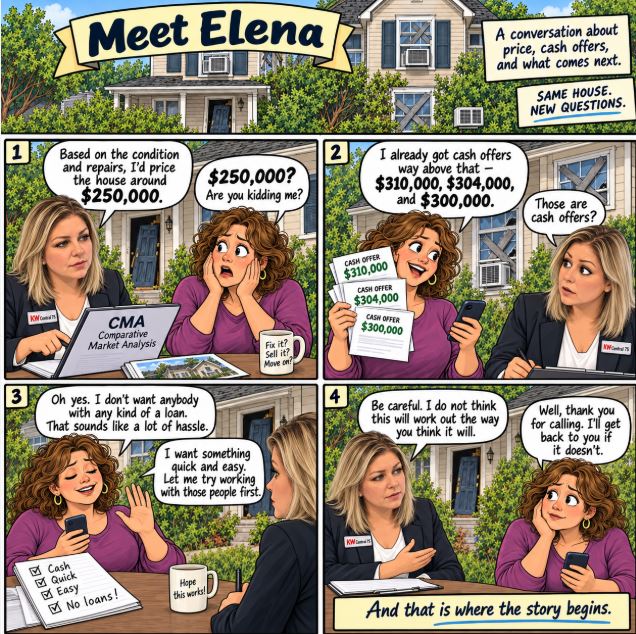
Eventually, she asked me to price it.
At the time, fully remodeled homes in her neighborhood were selling roughly in the $340,000 to $380,000 range, depending on size and features. Homes that were not remodeled but were still reasonably move-in ready were selling closer to $300,000. Sherry’s house was neither remodeled nor move-in ready. Once I looked at the amount of work that would be needed just to bring the property to a condition where a typical FHA, VA, or conventional buyer could realistically finance it, I recommended pricing it around $250,000.
Sherry looked at me like I had lost my mind.
Sherry: “Two hundred and fifty thousand? Are you kidding me?” Elena: “No. Why?”
Sherry: “Because I already have multiple cash offers way above that.” That got my attention. Elena: “How much?”
Sherry: “The one I like is $310,000. I also have one for $304,000 and another for $300,000.”
Elena: “Those are cash offers?” Sherry: “Oh, yes. And honestly, I don’t want anybody with any kind of a loan. That sounds like a lot of hassle. I want something quick and easy.” She thanked me for calling and told me she wanted to try working things out with the cash buyers first.
I warned her to be careful. Elena: “I really don’t think this is going to work out the way you think it will.”
Sherry was not convinced. Sherry: “Well, then I’ll get back to you if it doesn’t.”
And that is where the story begins.
Misconception #1: “I Signed a Contract, So I Sold the House”
About a month later, I called Sherry to see how things were going with the cash offers.
Elena: “So, how is it going?” Sherry: “Great. I sold the house.” Elena: “Congratulations! You already got the money?” Sherry: “Oh no, not yet.” Elena: “Did you close?” Sherry: “No. I don’t think so.”
Elena: “Then you haven’t sold the house yet. You signed a contract that may lead to a sale. That is not the same thing as a completed sale.”
Sherry was not interested in the distinction. Sherry: “Well, as far as I’m concerned, I sold the house.”
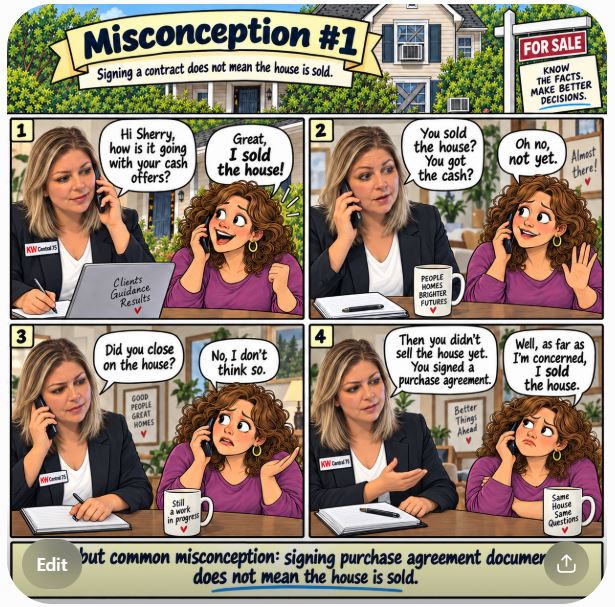
And this was the first major misunderstanding. A signed purchase contract is an important step, but it is still only a step. The buyer has not necessarily met all the contract conditions. The buyer has not delivered the $310,000 to the title company escrow account. The title company has not necessarily closed the transaction. The money has not necessarily been funded. Ownership has not necessarily transferred.
Until those things happen, the seller has a contract to sell the house, not the proceeds from a completed sale. That distinction may sound technical when everything is going well. It becomes much more important when things start going wrong.
So What Did “Cash Offer” Actually Mean?
At that point, Sherry still was not very interested in my distinction between “I signed a contract” and “I sold the house.” As far as she was concerned, the house was sold. But then she added something that got my attention.
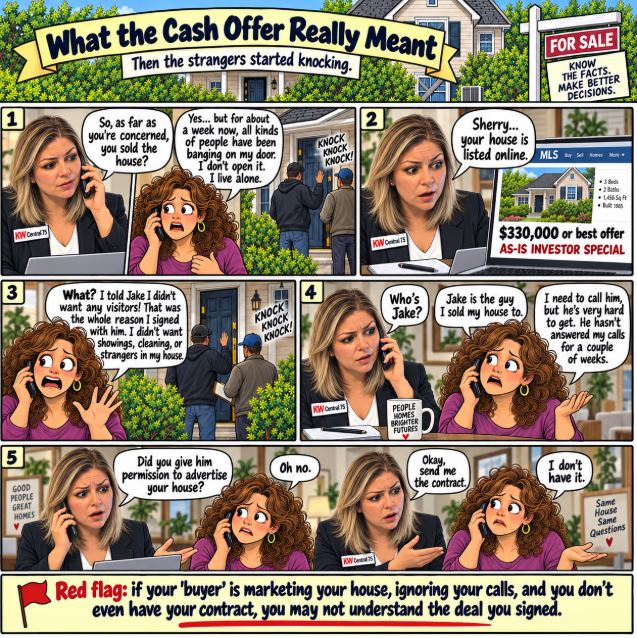
Sherry: “The only problem is, for the last week or so, all kinds of people have been banging on my door. Is that something I should be concerned about? I don’t open. I live alone.”
I immediately pulled up the MLS information and checked her address. Sure enough, there it was. Her house was being advertised online for $330,000, marked “or best offer,” “as is,” and described as an investor special.
Elena: “Oh — so you have an active listing?” She sounded confused. Sherry: “What? I told Jake I didn’t want any visitors. That was the whole reason I signed with him.”
Elena: “Who’s Jake?” Sherry: “Jake is the guy I sold my house to.” Elena: “And you told him you didn’t want people coming through the house?” Sherry: “Yes. I specifically told Jake the reason I wanted a cash offer was so I wouldn’t have to do showings, clean the house, or have strangers walking through my house.” Elena: “Well, as of right now, your house is being advertised online, and the people banging on your door are probably trying to see it.”
Sherry was upset. Sherry: “Well, I need to call Jake and straighten this out.” Then she added something even more troubling. Sherry: “The only problem is, he’s very hard to get ahold of.”
Elena: “What do you mean?” Sherry: “He hasn’t really been answering my calls for a couple of weeks now.”
At that point I asked the next obvious question. Elena: “Did you give him permission to advertise your house?” Sherry: “Oh, no, that is why I wanted to sell cash, so it would not be online. I don’t want strangers in my house.”
Elena: “Is there something in the contract that allows him to list the house in the MLS?” Sherry: “I don’t know. I think so.” Elena: “Okay. Send me the contract.” Sherry: “Well… I don’t have it.”
Why This Was a Serious Red Flag
Sherry believed she had sold her house to Jake for cash. Yet her house was being marketed to other buyers at a higher price, strangers were showing up at her door, Jake had stopped returning her calls, and Sherry did not even have a copy of the agreement she had signed.
At that point, the question was no longer simply: “How much did Jake offer?” The more important question became: “What exactly did Sherry agree to — and what was Jake actually doing with that agreement?”
Sherry Did Not Even Have the Copy of the Sale Contract
At that point, I was already concerned. Her house was being advertised online without her knowledge or permission. Strangers were banging on her door. Jake was not returning her calls. And now Sherry was telling me she did not even have a copy of the contract she had supposedly signed.
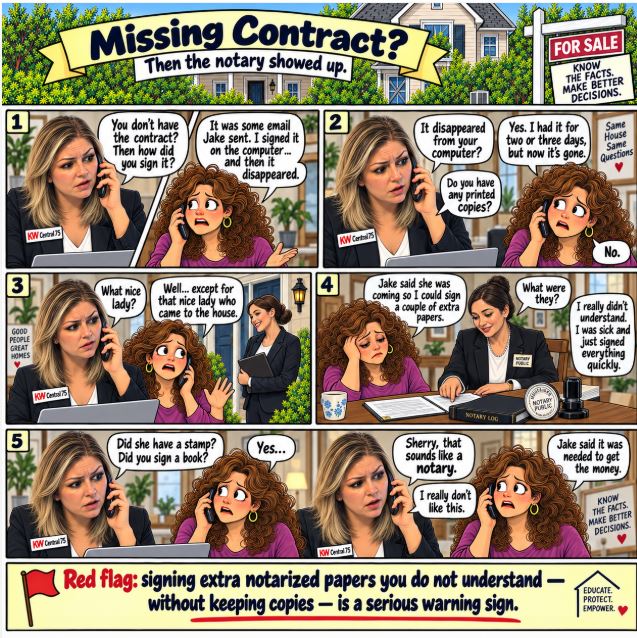
Elena: “You don’t have the contract? Then how did you sign it?” Sherry: “It was some email he sent me. I signed everything on the computer. But after a couple of days, it disappeared.”
Elena: “It disappeared from your computer?” Sherry: “Yes. I had it for two or three days, and now it’s gone. Elena: “Did you print anything? Do you have any physical copies?” Sherry: “No.”
Then she added something that made the story even stranger.
Sherry: “Well… except for that nice lady who came to the house.” Elena: “What nice lady?” Sherry: “Jake said somebody would be coming by and that I needed to sign a couple of additional papers.”
That stopped me.
Elena: “Wait. A lady came to your house, and you physically signed papers for her?” Sherry: “Yes.” Elena: “How many?” Sherry: “Just a couple.” Elena: “What were they?”
Sherry had no real answer.
Sherry: “I didn’t really understand. I wasn’t feeling well that week. And the day she came over, I had very bad stomach pains. She was very nice and polite, but honestly, all I wanted was for her to leave so I could lie down. So I just signed everything quickly.”
Elena: “Did she have a stamp with her?” Sherry: “Yes. A little stamp.” Elena: “Did you have to sign a book too?” Sherry: “Yes. Some book.”
Now it clicked.
Elena: “Sherry… it sounds like a notary came to your house.” Sherry: “Oh yes, Jake said there was going to be a notary coming, yes.”
That bothered me immediately. A seller not understanding the purchase contract is one problem. A seller signing additional notarized documents, while sick, without understanding what they are, is a much bigger problem. So I asked the question that was now running through my mind.
Elena: “Why would you need a notary for this?” Sherry: “I have no idea. Jake said it was needed for me to get the money.”
Why This Was a Serious Red Flag
At this point, the issue was no longer just that Sherry was confused. The issue was that she had:
- signed documents she did not understand,
- failed to keep copies of what she signed,
- allowed a notary to witness additional paperwork,
- and still could not clearly explain what any of those extra documents were supposed to do.
That is how people can end up agreeing to far more than they realize. A homeowner may think they are simply signing papers “to get the money,” when in reality they may be signing documents that affect control of the property, the ability to market it, or other rights they did not intend to give away.
And Sherry still believed she had done something simple: she thought she had sold her house for cash. What she actually had was a pile of unanswered questions.
Mike, Red Robin LLC, and a House Listed from Iowa
Sherry was still sitting across from me at the kitchen table when she mentioned something else.
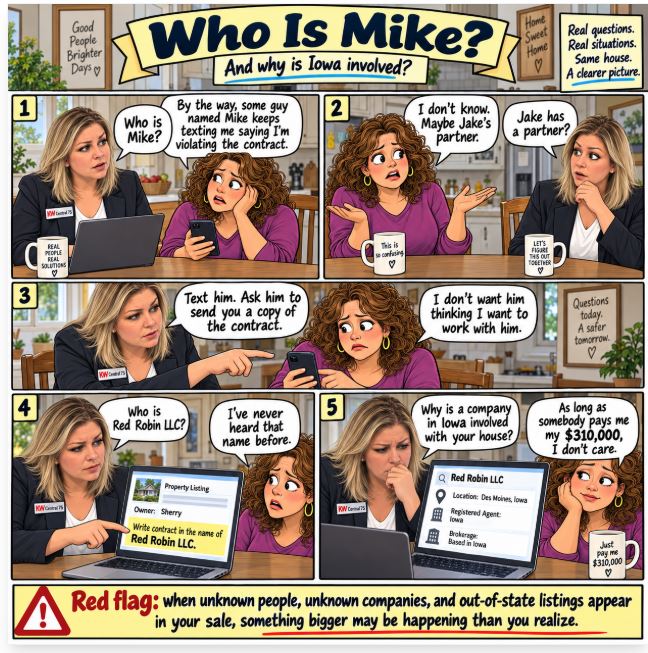
Sherry: “By the way, some guy named Mike keeps texting me saying I’m violating the contract.”
I stopped what I was doing. Elena: “Who is Mike?” Sherry: “I don’t know. Maybe Jake’s partner.” Elena: “Jake has a partner?”
Sherry shrugged. She had been deleting Mike’s messages because she did not understand them and did not want him to think she was interested in dealing with him.
I told her not to delete the next one. Elena: “Text him. Ask him to send you a copy of the contract.” She did not want to. Sherry: “I don’t want him thinking I want to work with him.” Elena: “Forget that for a minute. We need to see what you signed.”
While we waited, I pulled up the online advertisement for the house again and started reading it more carefully. The owner in the tax records was listed as Sherry. But the instructions said that any offer should be ignore the tax records information and instead use the name of Red Robin LLC as the house owner.
I turned the laptop toward her. Elena: “Who is Red Robin LLC?” Sherry: “I have no idea.” Elena: “Is that Jake’s company?” Sherry: “I’ve never heard that name before.”
So I looked it up. The company appeared to be a small wholesaling business in Iowa. Then I looked at the brokerage advertising the house. A real estate brokerage also from Iowa. I looked back at Sherry.
Elena: “Why is a company in Iowa involved with your house?” Sherry: “I don’t know.”
At this point, Sherry had signed papers she could not find, a man named Jake had stopped returning her calls, another man named Mike was accusing her of violating a contract she did not have, and a company she had never heard of was now appearing as the seller of her house.
Sherry still had the same answer. Sherry: “As long as somebody pays me my $310,000, I don’t care.”
I did. Because by then, I had no idea who was actually controlling this transaction. And neither did Sherry.
Then I Called the Listing Agent for Sherry’s House
At this point, I wanted to know one thing: Who had actually told this brokerage they were allowed to advertise Sherry’s house? So I called the listing agent in Iowa.
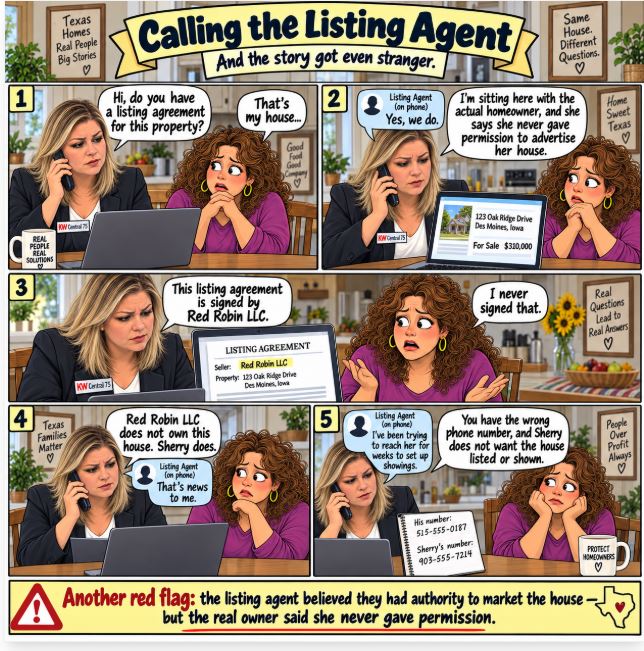
Elena: “Do you have a listing agreement for this property?” Listing Agent: “Yes.” Elena: “I’m sitting in front of the actual homeowner right now, and she says she never gave anybody permission to list or advertise her house. Would you please send me a copy of the listing agreement? I’m her agent.”
A little while later, I was looking at the copy of the listing agreement. And the seller named on the listing agreement was not Sherry. It was Red Robin LLC.
I called the listing agent back. Elena: “Red Robin LLC does not own this house. Sherry does. And Sherry never signed a listing agreement with you.” There was a pause. Listing Agent: “That’s news to me.” Now we had another problem. Elena: “Do you have a phone number for whoever signed the listing agreement?”
Then he asked me something surprising. Listing Agent: “If you’re sitting in front of Sherry, do you have her correct phone number?” Elena: “Yes.” Listing Agent: “Because I’ve been trying for a couple of weeks to reach her to arrange showings.”
We compared numbers. The phone number he had for Sherry was wrong. So while Sherry had been sitting at home wondering why strangers kept appearing at her door, the brokerage had apparently been trying to reach her at a phone number that did not belong to her.
Elena: “At this time, Sherry does not want the house shown, and she does not want it advertised. But before anything else happens, we need to figure out exactly what Red Robin LLC believes it has the right to do.” I asked him to pass my information to the person who had signed the listing agreement. Elena: “Because right now, you have the actual homeowner sitting here saying she does not want this property listed.”
The listing agent sounded genuinely surprised. Listing Agent: “Well, it sounds like she must have signed something giving them permission to advertise it.” Elena: “Do you have a copy of that?” Listing Agent “No.” Another pause. Then he said: “I’ll have somebody call you.”
And once again, Sherry and I were sitting at the kitchen table with more questions than answers. Somebody she had never heard of had signed paperwork to advertise her house. The brokerage believed that company had the authority to do it. The brokerage had been trying to arrange showings with a phone number that was not even Sherry’s. And somewhere, apparently, there was another document that was supposed to explain why all of this was allowed.
Neither Sherry nor I had seen it.
Sherry Finally Gets A Copy Of Her Sale Contract, Plus The Notarized Documents
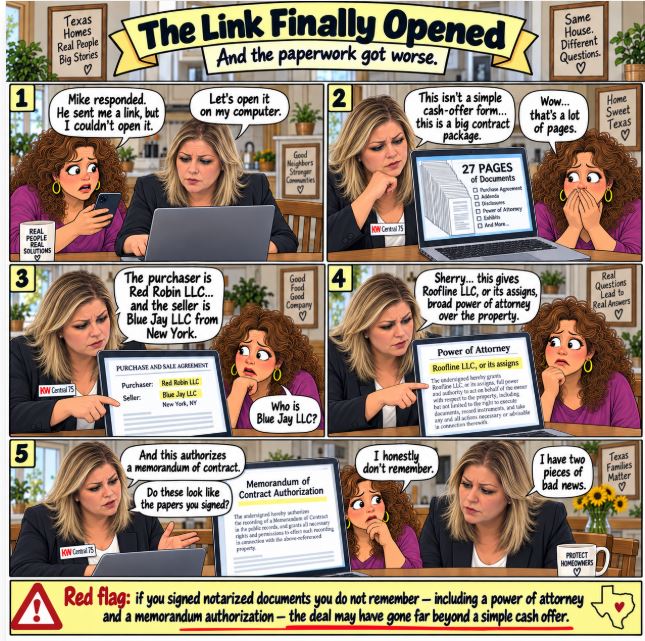
The next day, Sherry sent me a message. Sherry: “Mike responded. He sent me a link, but I can’t open it.”
So I went back to her house, opened my laptop, and we pulled up the link together. This time, we finally had documents. What appeared on the screen was not a short, simple agreement. It was a stack of scanned papers — roughly 27 pages — and the whole thing looked polished, professional, and very carefully written. It looked like the kind of contract that had been put together by someone who knew exactly what they were doing.
As I started reading, one thing became clear very quickly: This was not a friendly little download-off-the-internet 2-page agreement. This was a serious set of documents, and they were written heavily in favor of the buyer’s side.
Then the names started getting stranger. The purchaser was listed as Red Robin LLC. But the seller was listed as Blue Jay LLC, a company from New York.
Elena: “Who is Blue Jay LLC?” Sherry: “I have no idea.”
So now we had gone from Jake, to Mike, to Red Robin LLC, and now to a completely different company out of New York. Sherry had no idea who any of them were.
And then, buried in the documents, I found exactly what I had been afraid to find. The first document was a power of attorney. It gave Roofline LLC, or its assigns, broad authority to do what they needed to do in order to deal with this property. The second document was an authorization related to filing a memorandum of contract.
I turned the papers toward Sherry. Elena: “Do these look like the papers you signed in front of the notary?” She looked at them for a moment. Then she said the words I was afraid I would hear. Sherry: “I honestly don’t remember what I signed.”
At that point, I looked at her and said: Elena: “I have two pieces of bad news.”
And that is where we will stop for now. Because each of those documents deserves its own explanation.
The First Piece of Bad News: The Power of Attorney
The first document that really worried me was the power of attorney. The document gave Roofline LLC, or its assigns, a long list of powers connected to the sale of Sherry’s property. The list was broad, and it ended with language allowing other reasonable actions needed to secure or complete the sale. What concerned me just as much was what I did not see. There was a beginning date. I could not find an expiration date.
I turned to Sherry. Elena: “Do you know what a power of attorney is?” Sherry: “Yes.” Elena: “When you signed this, did you actually see the words ‘Power of Attorney’?” She looked at the document again. Sherry: “Yes. Now that I see it again, I remember this one.”
That made the next question unavoidable.
Elena: “Then why didn’t you call somebody? Me, an attorney, somebody who understands real estate — and ask what you were giving them permission to do?” Sherry: “I was really sick that week. “
Jake had told her that somebody would be coming to the house with a couple of additional papers that needed to be signed in person. When the notary arrived, Sherry was having severe stomach pain. She told the woman she was not feeling well.
Sherry: “She was very nice. She said it would only take a few minutes. I just wanted her to leave so I could go lie down. So I signed everything.”
The whole visit may have taken five minutes. But now, weeks later, we were sitting at Sherry’s kitchen table trying to figure out what it meant for Sherry’s sale.
I looked at the document again. Elena: “Sherry, this appears to give them very broad authority involving the sale of your property, and I do not see an expiration date. I also do not know, just from looking at this, whether there are restrictions on your ability to revoke it or exactly what would be required to revoke it. But.. Actually, let me take that back. I’m a real estate agent. I’m not an attorney. This is where my advice stops.”
And I was not joking. At that point, Sherry indeed needed a lawyer to read the actual document and tell her exactly what authority she had given away, whether the power of attorney was still effective, and what would be required if she wanted to revoke it. Because now we were dealing with something much more serious than a confusing cash offer. Someone appeared to have written authority, signed by Sherry herself, to take actions involving the sale of her house.
A Very Important Lesson About Powers of Attorney
If somebody involved in buying your house asks you to sign a power of attorney giving them authority over you or your property, do not treat that document like routine transaction paperwork.
Stop. Freeze. Tell the cash buyer you need to review it with an attorney. And indeed, before you sign, have an attorney explain exactly what authority you are giving away, how long that authority lasts, and how it can be revoked. An experienced real estate agent may be able to recognize that the request is unusual and tell you that you need legal advice, but the legal effect of a power of attorney is something an attorney should evaluate.
A power of attorney is a very powerful document because it can allow another person or company to act on your behalf. Depending on how it is written, that authority can affect decisions, documents, and rights connected to your property.
That is why the worst thing you can do is glance at it, assume it is “just another paper needed for the cash sale,” and sign it.
And during a cash-offer transaction, there is one question every homeowner should immediately ask: Why does the person buying my house need the legal authority to act for me?
A buyer already has the right to act for themselves. If they are asking for the right to act for you, that is something very different.
In Sherry’s case, the power of attorney was the first clear sign that this transaction had gone far beyond someone simply agreeing to buy her house for $310,000. And unfortunately, there was still one more notarized document sitting in that stack.

The Second Piece of Bad News: The Memorandum of Contract
The second notarized document worried me for a different reason.
It was an authorization for a Memorandum of Contract.
I turned to Sherry.
Elena: “Do you know what a Memorandum of Contract is?”
Sherry: “No.”
So I tried to explain it as simply as possible.
Elena: “Imagine somebody puts a note in the public county records attached to your house. The note basically says: ‘Before anybody buys this house, you should know that I already have a contract involving this property.’”
It does not mean that person owns the house.
It is not the same thing as a mortgage lien.
But it can create a very real problem when the homeowner later tries to sell the property to somebody else, because the next buyer and the title company now see another person claiming contractual rights involving the house.
In practical terms, that can mean the memorandum may have to be dealt with or released before another sale can move forward cleanly.
Sherry stared at me.
Sherry: “But I never agreed for them to put a lien on my house.”
Elena: “It isn’t technically a lien. But I understand why it feels like one. If you try to sell the house to somebody else and this memorandum is sitting in the county records, the next title company is going to want to know what it is and whether the person claiming those rights has released them.”
That was when Sherry remembered something.
Sherry: “Wait. Mike kept telling me I was violating the contract. He said they were going to put a memorandum on the property. Is this what he was talking about?”
I looked back at the paperwork.
Elena: “Yes. This appears to be exactly what he was talking about.”
And there was another uncomfortable detail.
Sherry herself had signed the authorization in front of the notary.
That matters because Texas changed the law effective September 1, 2025, creating new procedures and protections involving a unilateral memorandum of contract — meaning one signed only by somebody who is not the property owner. The statute gives homeowners a process for challenging and releasing those unilateral filings. But Sherry’s situation was different: she had apparently signed the document herself. That meant I was not going to assume those newer protections solved her problem. She needed an attorney to look at the actual paperwork.
At this point, I had had enough guessing.
Elena: “Call Mike.”
Sherry: “Now?”
Elena: “Yes. Get him on the phone and let me talk to him.”
And that conversation with Mike is where we finally started learning what these people believed they had actually bought.
A Warning About Memorandums of Contract
Just like a power of attorney, a Memorandum of Contract is not something I would treat as routine paperwork in a cash-sale transaction.
If somebody asks you to sign a document allowing a memorandum to be recorded against your property, stop and find out exactly what it does before signing it.
A memorandum does not automatically transfer ownership of your house, and it is not technically the same thing as a lien. But recording one can put the world on notice that somebody claims contractual rights involving your property. That can complicate a later sale until those claimed rights are resolved.
And after the 2025 Texas law change, I would be especially careful about giving a blanket statement such as “they can always file one without your signature.” Texas now has specific rules for unilateral memoranda involving residential property, including notice requirements and a statutory process that may allow an owner to neutralize the memorandum’s effect. The exact result depends on the document and how it was filed, which is why this is attorney territory.
For Sherry, however, the immediate problem was much simpler.
She had signed something she did not understand.
Now somebody was telling her that document could interfere with what she did next with her own house.