
Home Sellers’ Math vs. Home Buyers’ Math Paradox: Why The Best Deals Can Be Hardest to Sell
October 15, 2026
Understanding objective value, subjective value, and the Seller’s Paradox
Seller Are From Mars, Buyers Are From Venus, or Sellers Logic and Buyers Logic are Two Different Logics
Part 1: To Solve The 2-Logics Mystery, Let’s Go Shopping for a Car
Before we delve into the topic of selling houses, I’d like to invite you to participate in a little mental exercise.
Over my years in real estate, I’ve observed something fascinating. Buyers and sellers are frequently mystified by each other’s decisions. Sellers cannot understand why buyers reject properties that, in their opinion, represent extraordinary bargains. Buyers cannot understand why sellers insist on prices that seem unreasonable, especially when the property obviously needs work. Both sides are convinced that their reasoning is perfectly logical. And both sides often believe the other is being completely irrational.
As a real estate professional, I’ve had the opportunity to observe these decisions from both sides. And I’ve discovered that the easiest way to explain this mystery is to temporarily forget about real estate altogether.
Instead, let’s imagine you’re shopping for a car.
A Beautiful Toyota and an Incredible Subaru
Imagine that are a responsible husband, and your wife needs a new car. You’re a responsible, educated, logical, careful buyer. You work hard for your money, research your purchases, compare prices, and understand the importance of getting good value.
You’ve been approved for up to $20,000 in car financing.
One Saturday morning, you take your wife and children to a dealership.
Your wife immediately walks up to a shiny, pretty Toyota. It’s beautiful! The paint is so perfectly polished that you can practically see your reflection in it. The windows sparkle. The seats are spotless. The interior looks practically brand new. And the smell! That wonderful new-car fragrance. You know well that the smell is just from a spray can, but still! The smell makes you see your wife smiling, your kids smiling, your parents proud, and you standing next to your family, proud and happy.
Your wife opens the door and slips behind the steering wheel. She smiles as she runs her hands over the clean dashboard. The children are practically climbing over each other, eager to jump into the back seat. “Daddy, can we take it home today?”
You turn the ignition key. The engine starts immediately and humms gently and evenly. All stereo equipment is colorful and modern. The air conditioning blows ice cold, the transmission shifts smoothly, and the vehicle drives and turns beautifully.
The asking price is $20,000.
Now, being the financially responsible person that you are, you’ve done your homework. You know that this particular Toyota’s true market value is probably closer to $18,000. So yes, you’re overpaying by approximately $2,000. But the car is within your budget, and it’s exactly what your family needs.
With $2,000 down, your estimated payments would be approximately $400 per month. Most importantly, your wife can start driving this car tonight. She can take the children to school tomorrow, drive to work, and proudly show her new car to her friends tomorrow as well.
It’s a beautifully finished product. You’re almost ready to purchase it. But being the responsible adults that you and your wife are, you decide to consider one more opportunity before making your final decision.
Another salesperson approaches you. “Wait a minute!” he says enthusiastically. “Before you buy that Toyota, let me show you something MUCH better!”
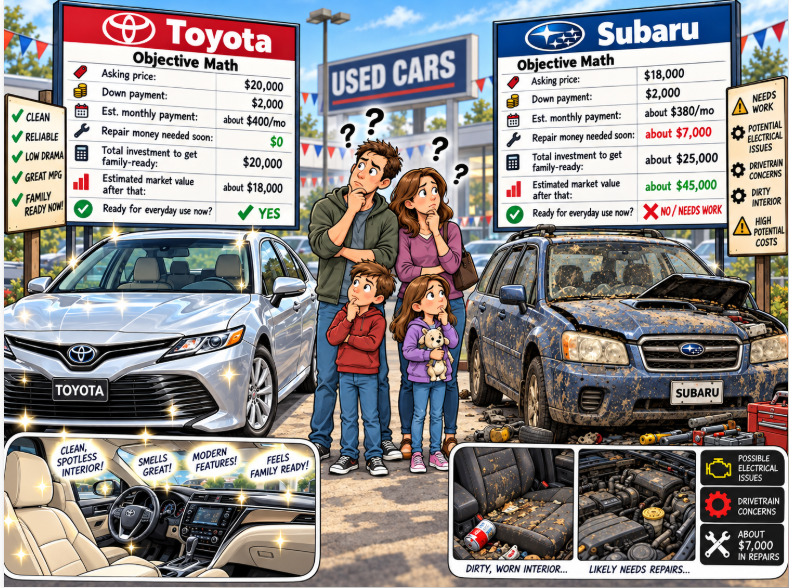
He walks you over to a dusty but powerful looking Subaru. And you have to admit, the Subaru is impressive. You are not a car expert, but even you can see that it is a higher-end vehicle with luxury package and much more powerful engine, more safety features, more luxurious although somewhat worn leather seating, and potentially superior engineering.
In fact, the salesperson explains that a Subaru like this, in excellent condition, could be worth as much as $45,000 or $50,000 with the same mileage.
And the asking price? Only $18,000! Eighteen thousand dollars for a vehicle potentially worth forty-five thousand! Now THAT sounds like an opportunity.
Of course, there’s a small catch. Actually, several small catches.
The Subaru isn’t nearly as polished as the Toyota. The interior is dirty and dusty. There are a few cuts in the leather, some worn areas on the seat belts, and several interior finishes that have clearly seen better days.
But those are just cosmetic issues. Then the salesperson mentions a few mechanical concerns. The transmission works, but there may be electrical issues that should be easy to troubleshoot. The drivetrain might need some attention but nothing major. None of those issues are terribly serious, he assures you.
A mechanic has estimated approximately $6,000 to $7,000 in repairs.
“It’s perfectly drivable right now, you just need to get it serviced and cleaned asap!” the salesperson explains. “You can start using it immediately and gradually improve it as you save money. And the best part is that you can make all those improvements exactly to your liking! And you get a much better car at the end!”
You and your wife exchange glances. The Subaru certainly has potential. And if the salesperson’s estimates are accurate, this could be an incredible investment.
Objective Math: Which Car Is the Better Deal Objectively?
Let’s start with the numbers.
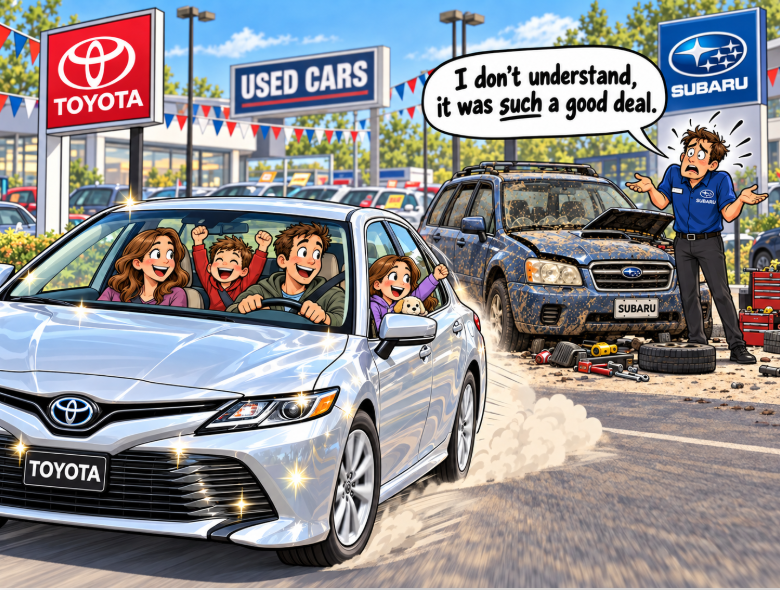
On one hand, the Toyota has an estimated market value of $18,000, but the dealer wants $20,000. You’re paying a $2,000 premium for a clean, polished, fully functioning vehicle you can drive home immediately, but you know the kids love the car.
The Subaru, meanwhile, has a potential repaired value of $45,000. You can buy it for $18,000 and supposedly spend another $7,000 fixing it. That’s a total investment of $25,000 for a vehicle potentially worth $45,000. Assuming all those estimates are correct, you could have approximately $20,000 in additional vehicle value.
Compared with the Toyota, the Subaru looks like an extraordinary bargain. Objective Math seems to be screaming: BUY THE SUBARU! But before you sign the paperwork, another type of calculation begins taking place in your head.
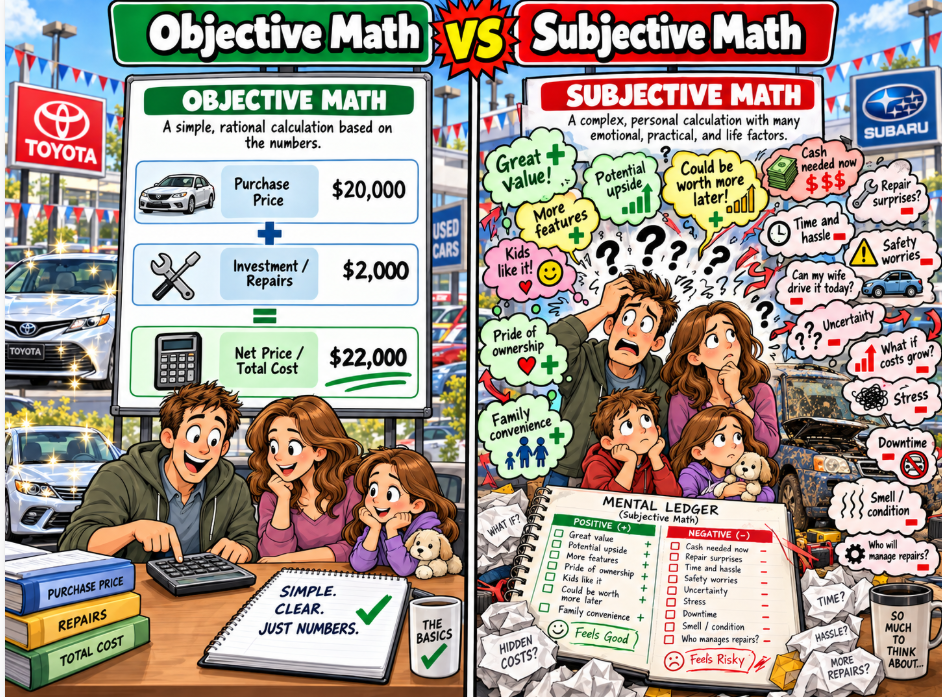
Subjective Math: What Will This Purchase Actually Cost ME?
Let’s consider the Toyota first. You need $2,000 in cash for the down payment. Your monthly payment will be approximately $400. And that’s it. Your wife gets into the car, turns the ignition key, and drives home tonight.
Let’s call that the Value of Now. How much is Now worth? There’s no universal dollar amount. It depends entirely on the buyer’s circumstances. But in this particular example, you’re willing to pay $20,000 for a Toyota that you believe is worth only $18,000. You’re effectively accepting a $2,000 premium for a finished, immediately usable product that solves your family’s problem today.
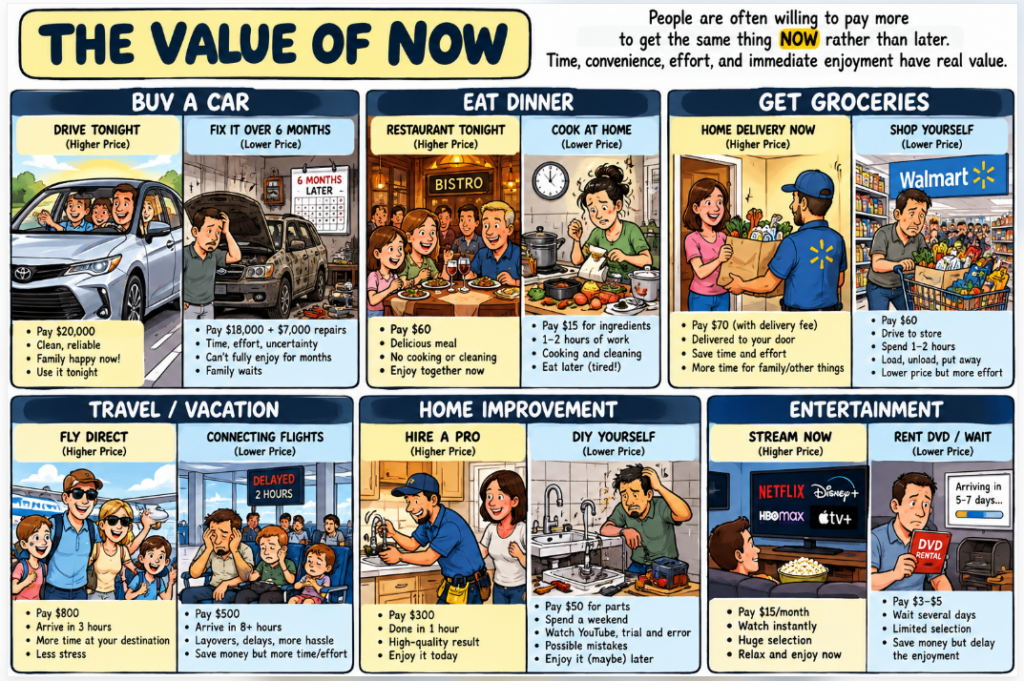
Now let’s examine the Subaru. Assuming the dealership can finance it despite its condition, you could also put $2,000 down. Your estimated payment might be slightly lower, perhaps $380 instead of $400. Wonderful! You’re saving $20 per month! But there’s another problem. To get the Subaru into the condition your imagine a good car to be in, you’ll need at least another $7,000.
So the Toyota requires $2,000 in immediate cash, while the Subaru requires a minimum of $9,000 between the down payment and repairs. And that $9,000 is only the beginning of the uncertainty.
- What if the repairs don’t cost $7,000?
- What if they cost $12,000?
- Or $17,000?
- What if the mechanic missed something important?
You don’t know anything about automotive electrical systems. You’ve never repaired a drivetrain. You have no idea how to evaluate whether the seller’s repair estimate is accurate. You are being asked to accept the seller’s opinion about expenses you have no ability to verify yourself.
And then there’s another issue. Do you really want your wife driving a car with potentially unresolved mechanical problems?
- What if something fails while she’s taking the children to school?
- What if she gets stranded on the highway?
- What if the car has to spend two weeks in the repair shop?
- And who exactly is going to organize those repairs?
You know the answer. You. You’ll be the one researching mechanics, scheduling appointments, obtaining estimates, dropping off the Subaru, arranging transportation, and making sure the repairs were completed properly.
You have a job. You have children. You have responsibilities. And frankly, you have neither the time nor the interest to become the project manager of a Subaru restoration.
Then you consider the supposed $20,000 in additional value. Yes, if you were planning to repair the Subaru and immediately resell it, that potential difference between your investment and its market value would be extremely attractive. But that’s not your plan. You want your wife to drive this car for years. Both cars will take her to work. Both will take the children to school. Both will take your family to the grocery store.
The Subaru may have better seats, engineering, and features, but how much will those advantages actually improve your family’s everyday experience? And how much are you willing to spend—in cash, time, inconvenience, and uncertainty—to obtain them?
You look back and forth at the Toyota and Subaru side by side. The children are waiting impatiently for you to make a decision, but they made it clear which car THEY want. And now you have a decision to make.
Which would you choose: a slightly overpriced polished and finished product that solves your problem tonight, or an extraordinarily valuable opportunity that requires additional cash, effort, work, time, and uncertainty before you can fully enjoy it?
Take a moment to make your decision. Because the distinction between those two calculations is exactly what we’re going to explore next.
Let me guess? if you are like most car buyers, chances are, you will regret paying $2,000 for Toyota, but you will end up buying a Toyota, even though OBJECTIVELY, you know that Subaru is a better car, and cheaper, too.
How Much Does One Dollar Cost?
Let me ask you a seemingly ridiculous question. How much is one dollar worth?
One dollar, obviously! Everybody knows that. Or do they?
After years of watching people negotiate real estate transactions, I’ve developed my own rather unscientific theory about the value of money. It goes something like this:
If it’s YOUR dollar, it’s worth approximately $0.40 to ME. If it’s MY dollar, it’s worth approximately $1.40 cents to ME.
Of course, I’m exaggerating to make a point. The purchasing power of a dollar doesn’t actually change depending on who owns it. But its perceived value certainly does!
Let’s return to our Subaru salesperson. Remember how casually he explained that the vehicle needed $7,000 in repairs?
“Oh, that’s nothing! You can take care of those things gradually. Just save a little money and fix them whenever you have time!”
Seven thousand dollars! To the salesperson, those repairs are a minor inconvenience. After all, he’s not the one who will be paying for them. But imagine asking that same salesperson to take $7,000 out of his own savings account and pay for your Subaru repairs before selling it to you. Suddenly, I suspect, he will hesitate.
He might tell you that he has other financial obligations. That he doesn’t want to tie up his savings. That he has neither the time nor the inclination to manage mechanics and repair shops. And he might be absolutely right!
But notice what happened. When YOU were expected to pay the $7,000, the repairs were a minor inconvenience. When HE was expected to pay the same $7,000, they became a serious financial decision.
The repairs didn’t change. The amount didn’t change. Only the person expected to pay for them changed.
And that brings us to something even more interesting. A dollar is not simply a dollar when we’re making purchasing decisions. We also assign value to our time, convenience, certainty, and peace of mind.
Remember the Toyota? You knew it was probably worth $18,000, yet you were considering paying $20,000.
Why would an intelligent, financially responsible person voluntarily pay $2,000 more than something is worth?
Because you weren’t purchasing only the vehicle.
You were also purchasing the ability to drive it home tonight.
You were purchasing the confidence that your wife could start using it immediately.
You were avoiding the inconvenience of arranging repairs, the uncertainty of unexpected expenses, and the responsibility of supervising work you didn’t know how to evaluate.
You were willing to pay a $2,000 premium for the value of NOW. And that’s a perfectly legitimate consideration.
Now consider the Subaru again. The salesperson wants you to treat the $7,000 repair estimate as a fairly small expense compared to the value you would gain. But to you, it’s your hard-earned $7,000, possibly more. It’s money that could have been spent on family vacations, children’s education, retirement savings, or unexpected emergencies.
And unlike the Toyota’s $2,000 premium, which purchases immediate pleasure and convenience, the Subaru’s $7,000 buys you an additional open-ended project with uncertain expenses and an uncertain completion date.
Suddenly, the two purchases don’t look quite the same. And this is where financial calculations that look perfectly reasonable on paper begin producing very different decisions in real life.
Because when people calculate the value of a purchase, they don’t simply calculate what an asset is worth. They calculate what acquiring and using that asset will cost them. Not just in dollars. But in time, effort, risk, uncertainty, and inconvenience.
Which brings us to real estate, where the one dollar can suddenly FEEL worth $1.40 to the seller and only 40 cents when the buyer is expected to spend it.
How Much Is $300,000 Minus $30,000 Worth?
Let’s take our little experiment one step further. Imagine you’re selling a house. You’ve done your research, looked at comparable sales, and concluded that similar homes in beautifully updated condition are selling for approximately $300,000. Your house is fundamentally just as good. Perhaps even better in some respects. It has a good floor plan, spacious rooms, a convenient location, and solid construction.
But it needs some improvements. The carpet is old. The paint is dated. The bathrooms could use updating. The kitchen would look much more attractive with modern countertops and finishes. You’ve spoken with contractors, and your best estimate is that bringing the property up to the same condition as those $300,000 homes would cost approximately $30,000.
Now, being a financially responsible homeowner, you do some simple math.
$300,000 (the anchor) minus $30,000 (expenses) equals $270,000.
Or does it? Lets come back to this calculation in a minute.
You set your mental ANCHOR at $300,000 and allowed for reasonable repairs. You don’t particularly want to spend $30,000 renovating a house you’re about to leave. You have other things to do with your money and time. Besides, why should you choose the carpet, paint colors, and bathroom fixtures for someone else? Wouldn’t it be better to let the buyers make those decisions themselves?
So you list your property for $270,000. And from your perspective, you’ve done everything right. The house is worth $300,000 updated. You’re deducting the entire estimated renovation cost. You’re giving buyers the opportunity to customize the house exactly as they wish. What a wonderful opportunity for the next owner!
Except that the buyers don’t seem nearly as enthusiastic as you expected. Weeks pass. People tour the house, but nobody makes an offer.
Your real estate agent suggests reducing the price. Reluctantly, you agree to $260,000. Now you’re not just compensating buyers for the $30,000 in improvements. You’re offering them another $10,000 incentive! Surely they’ll recognize the bargain.
But the property still doesn’t sell. Eventually, you reduce it to $250,000. And now you’re genuinely frustrated. “Wait a minute!” you tell your agent. “Updated houses are selling for $300,000!” “My house only needs $30,000 worth of improvements!” “I’m offering it for $250,000!” “That means I’m giving the buyer an EXTRA $20,000 in value! At this point, I’m practically giving the house away!”
And from your perspective, you’re absolutely convinced that your calculations are correct. In fact, assuming the estimated updated value and renovation costs are accurate, the arithmetic itself is perfectly reasonable. But there’s something missing.
You’re calculating the value of the house from the perspective of someone who DOES NOT WANT TO SPEND YOUR OWN MONEY. You’re asking, “How much of my property’s potential value am I willing to give away to avoid doing the renovations myself?“But that’s not the question your buyers are trying to answer.

Now Let’s Look at the Same House Through the Buyer’s Eyes
Imagine a buyer who has been approved for a $250,000 mortgage purchase. They find your house advertised at $250,000. And immediately, they establish a very different ANCHOR. They are NOT considering homes worth $300,000, they are only looking at homes in their price range.
They see your house advertised for $250,000. That’s the price you’ve publicly offered to accept, so it MUST be a reasonable and fair price, they think, otherwise why would you price it that way.
They compare it with other properties they’ve toured recently. Some are smaller. Some are less conveniently located. Some might have less attractive floor plans. But many are already updated.
So the buyer starts thinking: “Okay, this house costs $250,000. But the carpet needs replacing. The paint needs updating. The bathrooms need work. We would probably need another $30,000 to make it look like the other houses we’ve seen.”
And now they start doing their own calculations.
$250,000 (the anchor) minus $30,000 (expenses) equals $220,000.
They might conclude that $220,000 would be a generous offer, given that $30,000 is just the monetary cost, and they have not even accounted for their own time and sufferings through the inevitable hazards of dealing with a large repair project.
But notice something. The seller started at $300,000 (their anchor), subtracted the renovations, and believed $270,000 was fair. The buyer started at the advertised $250,000 (their anchor), subtracted the same renovations, and arrived at $220,000.
The same $30,000 repair estimate. Two completely different starting points. Two very different conclusions of what is a FAIR price.
But here’s the real problem. Even if you now list the house at $220,000 (which may create a new anchor), do not expect a flood of full price offers to come in. Because the same buyers look at the house, say, the price looks fair, but “Where are we going to find the $30,000 to fix it?”
They might qualify for the mortgage. They might have enough money for their down payment and closing expenses. But that doesn’t mean they have another $30,000 in cash to work on repairs.
And your generous discount doesn’t create that cash. it just makes the conversation possible. The bank doesn’t ordinarily hand them the difference between your original asking price and the lower purchase price as a renovation allowance. So even at $220,000, the house may feel to them as a great deal that remain logistically impractical for them to actually put an offer on.
Meanwhile, they can purchase another property for $250,000, with completed improvements already reflected in the purchase price and painlessly financed through their mortgage.
Enough About the Problems. What’s the Solution?
First things first. Lets agree that the objective math (Subaru being an extraordinary bargain) breaks in the face of the evidence provided by life itself . Therefore, replying on objective math to appeal to buyers is like talking Marsian language to the residents of Planet Venera.
The buyers who want an expensive Subaru don’t want the repairs. And the buyers who need an inexpensive car cannot afford the repairs.
Think about it. The people who are shopping for a $45,000 Subaru are generally looking for a beautiful, well-maintained vehicle with the features, comfort, and performance they expect at that price. They’re not necessarily interested in buying a damaged Subaru and spending the next several months restoring it.
Meanwhile, people shopping for an $20,000 vehicle are often looking for affordable, reliable transportation that looks just good enough to please the eye. They want something they can drive to work tomorrow morning without worrying about mechanical problems. They’re not looking for a $7,000 repair project either.
So who exactly is the real customer for that Subaru?
There might be a mechanic, a Subaru enthusiast, or a professional car flipper who recognizes the opportunity. But that’s a much smaller audience than the seller initially thought.
So what should the Subaru seller do? He has two fundamentally different choices.
What would YOU recommend to the Subaru seller?
- Should he invest that $7,000, complete the repairs, clean and polish the vehicle, and then offer it for $45,000?
- Or should he reduce the price to, say, 17K or 16K?
- Would doing so attract a completely different group of buyers?
- Or should he keep the Subaru in its current condition and continue lowering the price until he encounters someone who has the expertise, financial resources, and willingness to undertake the project?
Which decision would you make if the Subaru belonged to you?
Now let’s complicate the situation. What if the Subaru seller doesn’t have the $7,000? What if he simply cannot afford the repairs?
Then his options become considerably more limited. He may have no practical choice but to sell the Subaru in its current condition. And that’s unfortunate. But here’s something important. The seller’s financial difficulties do not automatically make the Subaru a good deal to the buyer. Depending on their level of experience, it may be a terrible deal.