
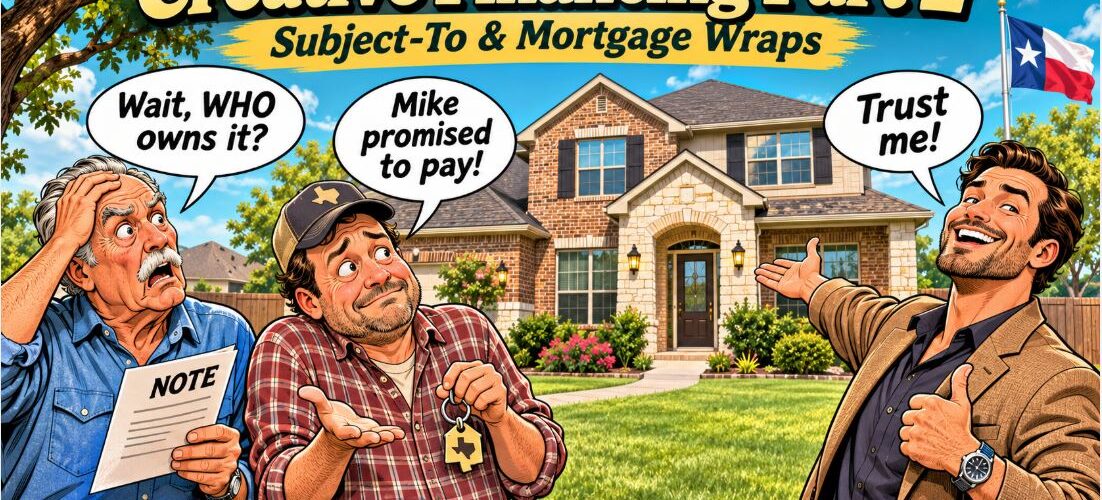
Subject-To and Mortgage Wraps in Texas: What Happens When You Sell Something You Still Owe Money On? – Part 2
November 3, 2026
by Elena Garrett, Realtor, Dallas, TX
This is Part 2 of a Creative Financing For Home Sellers series. Click here to read Part 1.
The Easy Way to Understand Sales Due To Existing Loans
Imagine that you have a car worth $20,000, and a good friend of yours named Buddy wants to buy it. There’s just one problem. He doesn’t have $20,000 in cash. So he asks: “Hey, could you sell me the car on payments? I’ll pay you back every month over the next five years, with interest!”
You like your friend. You’ve known him for years. But $20,000 is a lot of money, and friendship is one thing—lending money is another. So you do your homework.
- You check his credit history.
- You verify his employment and income.
- You check his driving record to make sure he is a good driver.
- You review his financial obligations and make sure he can comfortably afford the payments.
- You discuss the interest rate, the monthly payment, what happens if he’s late, and what happens if he stops paying altogether.
Finally, you’re satisfied. You know your friend, you’ve checked his finances, and you believe he’s a reasonable credit risk.
But being a particularly careful seller, you decide to put everything in writing. You prepare three documents.
Document #1: Transfer of Title:
You transfer ownership of the car to your friend. Congratulations! The car now legally belongs to him, subject to your recorded lien.
Document #2: Promissory Note
Your friend signs a document called a promissory note. It’s his written promise to repay the $20,000. It describes exactly how much he owes you, the interest rate, the monthly payments, and what happens if he doesn’t keep his promises.
Document #3: Security Agreement
Now, you’re not planning to spend the next five years chasing your friend around if he stops paying you. So you create a third document, called a loan security agreement. It establishes that the car serves as collateral for your loan and you put a lien in place to protect your interest in the repayment of the loan. You properly record your lien, giving you legal rights against the car if your friend defaults.
Due-on-Sale Provision In The Security Agreement
And, to be fully satisfied, you decide to take one additional precaution. You include a provision called DUE ON SALE. It basically says: “I’m lending this money to Buddy. If Buddy ever decides to sell or transfer this car to somebody else, I want the remaining balance of the loan to be paid off.”
Buddy looks through all the documents and agrees. He signs the documents, shakes your hand enthusiastically, takes his car keys, and drives away, smiling from ear to ear.
You’re happy. He’s happy. Everybody wins!
Six months later…
You see the car you sold to Buddy on the street, but some unknown family is behind the weel. You call Buddy to see what is going on.
You: “So, how’s that car treating you?” Buddy: “Oh, I don’t have it anymore. I sold it.” You: “YOU WHAT?!” Buddy: “Yeah, I sold it to this guy Mike.”
You: “Wait a minute! You still owe about $18,000 on that loan! And I have not seen you repay me for the car!” Buddy: “Yeah, I know. See, here’s what happened. I lost my job a couple of months ago, and I couldn’t afford the payments anymore. And if I sold the car outright, I wouldn’t get enough money to pay off your loan. But then I found this guy Mike online. He wanted to buy the car, but he did not want to take out a loan. So, he agreed to take the car and make the payments. So, he has the car and he is making payment now. Problem solved!”
You: “Problem solved?! Who’s Mike?” Buddy: “Oh, just some guy I met online.” You: “Some guy you met ONLINE? How long have you known him?” Buddy: “Well, I don’t actually know him.” You: “What do you mean you don’t know him? Have you even MET him?” Buddy: “No, not in person. I’ve seen his picture, though.” You: “His PICTURE?!” Buddy: “Yeah! And he seems like a really nice guy.”
You: “Wait a minute. How do you know Mike can afford to make my payments? Did you check his credit? Or his driving history? Or his background information? What is he is a wanted criminal? Do you know where he works? How much money he makes?”
Buddy; “Well, no. But he told me he’s done deals like this before. Apparently, he’s very experienced in these types of loan take overs. He says he does this all the time!” You: “Okay. Is he at least going to drive the car himself?” Buddy: “I don’t think so. I think he’s buying it as a rental.” You: “A RENTAL?!” Buddy: “Yeah. Apparently, he rents cars to other people.”
You: “So you don’t even know who’s going to be DRIVING the car?” Buddy “No. But Mike said he does this all the time, so there’s nothing to worry about!” You: “Nothing to worry about? What about insurance? Does he have insurance that actually covers a rental car?” Buddy: “I’m sure he does.” You: “You’re SURE? What if the car breaks down? Who’s going to repair it?” Buddy: “Well, Mike will!” You: “Does he have enough money to cover those expenses AND make my monthly payments?” Buddy: “I’m sure he does!”
You: “Have you seen his financials?” Buddy: “Well… no.” You: “So let me get this straight. I spent weeks checking YOUR credit, verifying YOUR income, and making sure YOU could afford this car. And now you’ve handed it over to a complete stranger you’ve never met, whose financial situation you know absolutely nothing about, and who may be renting it to OTHER strangers? And you’re telling me everything is fine because this guy you met online PROMISED to make the payments?”
The Story Continues….
Now, imagine that instead of a $20,000 car, we’re talking about a $400,000 house. It’s the same basic situation. Only the amounts are bigger. With a house, the ownership document is called a deed, and the document securing the loan is called a deed of trust.
But let’s stick with our car story. It’s easier to follow. Because there’s something else we need to find out.
You: “Wait a minute. How exactly did you sell my car to Mike? Did he know you still owe me for the car?” Buddy: “Yes, he knew that. And I had a couple of ideas on how the sale could work for everyone!” You: “Oh, boy. This should be interesting.”
Scenario 1: Subject To Existing Loan
Buddy: “See, at first I thought I’d simply let Mike take over my payments. He gets the car, starts making the monthly payments to you, and I don’t have to worry about them anymore. And you would still get paid in full every month! Everybody wins!”
You: “Hold on. So, in this scenario, Mike would simply start making the payments under OUR original signed loan agreement?” Buddy: “Exactly!” You: “And our promissory note would just stay in my hands until Mike pays off the car?” Buddy: “Yep! How easy is that!”
You: “But according to our paperwork, YOU are the one who still owes me the money?” Buddy: “Well… technically, yes. But Mike would be making the payments since he now has the car! I do not have neither the car, not the ability to make payments any more.”
And that, my friends, is the basic idea behind buying something SUBJECT TO AN EXISTING LOAN.
Mike gets the car, subject to (bound by the provisions of) the existing loan, and agrees to make the payments. But the original loan agreement between you and Buddy stays in place. Mike making payments doesn’t automatically make him your approved borrower or release Buddy from his debt.
Simple enough? Well, Buddy wasn’t finished.
Scenario 2: Mortgage Wrap
“But then I got to thinking…” You: “Oh, no. What now?” Buddy: “Well, I’m unemployed, right? And I could really use some extra money. So I thought, why should I just give Mike the car for what I owe you? Why not make a little profit?” You: “Profit? What profit?”
Buddy: “Well, I owe you about $18,000. So instead of selling Mike the car for $18,000, I sold it to him for $22,000!” You: “You did WHAT?” Buddy: “And that’s not even the best part! I charged him a higher interest rate than what I’m paying you!” You: “Wait. What???”
Buddy: “It’s pretty smart, actually! The way I have it set up, I gave a $24,000 loan to Mike, so Mike makes monthly payments to ME. I use part of that money to make MY monthly payments to YOU. And whatever is left over, I get to keep to spend on food and what not!”
You: “So let me get this straight. Mike doesn’t owe me anything directly?” Buddy: “Nope! Mike owes ME!” You: “And you still owe ME the original $18,000?” Buddy: “Exactly!” You: “So now we have TWO loans on one car?” Buddy: “Yes! One between you and me, and another between me and Mike!” You: “And Mike is paying you more than you’re paying me?” Buddy: “Right! See? You don’t need to worry, I can pay your loan because Mike is paying my loan!”
And THIS is the basic idea behind a MORTGAGE WRAP.
Instead of simply having Mike make payments toward the original loan, Buddy creates a brand-new financing agreement with Mike. Mike promises to pay Buddy under their agreement. Buddy still promises to pay you under your original agreement. Mortgage wrap means one mortgage inside of another (like the double-wrapped burrito, with first mortgage being the smaller burrito that was then wrapped into a larger tortilla, so now there are two layers of tortilla over one original burrito filling).
Two separate loans. Two sets of payments. The same car.
And Buddy thinks he’s found a way to make a few extra dollars every month while he’s looking for a new job. But there’s something bothering you. Something very important.
The Due On Sale Clause
You: “Buddy, do you remember the documents we signed when I originally sold you that car?” Buddy (visibly annoyed): “Of course!” You: “Do you remember that we had a provision saying that if you ever sold the car, you were supposed to pay me back the entire remaining balance?” Buddy: “We did? I do not really remember that part. Well, I already told you, lost my job! That changed the situation! What could I do? I couldn’t afford the payments, and Mike offered me a way out, and this was the only arrangement that made sense financially for me! Everything else would make my financials more difficult.”
You: “I hear you! But when I agreed to finance that car, I agreed to finance it for YOU. I checked YOUR credit. I verified YOUR income. I discussed every provision of our agreement with YOU. I never agreed to finance anything to Mike, I do not know the guy. And definitely I would never approved you giving the car to Mike without even knowing his financial situation.”
Buddy: “I know, but Mike will pay you, do not worry…” You: “Buddy, lets get this straight. We have a written agreement. One of the conditions says that if you sell the car or transferred the title to the car, I have the right to demand the entire remaining balance. That’s called a DUE-ON-SALE CLAUSE. And you signed this document!”
The Due On Sale Clause – Example in Action
Buddy: “Okay, but I don’t have $18,000 right now!” You: “And THAT is the problem. You’ve transferred the car without paying off the loan, and by doing so, you’ve violated the Due-On-Sale Clause our original agreement. I can now demand repayment of the outstanding balance. And at this point, if I wanted to, I could pursue my rights under our security agreement to take the collateral (the car), including starting the lawful repossession process.”
Buddy: “But you cannot take it back. It is now Mike’s car, the title is in his name” You: “That is what that paper called Security Agreement is all about, my friend! According to the Du-On-Sale provision of the Security Agreement, I can file a lawsuit for repossession of the car. The court will force the sale of the car through the court order. And once the car is repossessed, it can be sold to recover the money you owe me, subject to whatever the rules are governing repossession and sale.”
Buddy: “Ok… But then take it with Mike. Mike has the actual car! I have neither the car nor your $18,000.” You: “Oh no, the original loan agreement was in your name, I had no agreement of any kind with Mike, so the lawsuit would be against you.’ Buddy: “I hope you won’t do that, because I do not know how to take the car back, and do not have the money for the lawsuit, either.”
Buddy: “But hold on, I do not understand what the problem is! If Mike keeps making payments on the loan, then why do you care who owns the car?’ You: “I very much care, as my $18,000 are now depending on the good behavior of a person I never met and never agreed to do business with. How do you know that the story about him buying it to rent it out is true and that the business he is running is legitimate and pays its IRS taxes, for example? And even if it is true, what happens if his rental business is not producing enough money to cover the car payments? What if he stops paying car insurance? What if the car breaks and he cannot afford the repairs? How would he pay the loan THEN? Or, what if tomorrow he decides to sell it to yet another person he meets online? How would I recover my money then?”
…
What Would YOU Do In This Situation?
Now, let me ask YOU something. Imagine you’re the one who loaned $20,000 to Buddy. You’ve spent considerable time researching Buddy’s credit, verifying his income, and making sure he would be a responsible borrower. You’ve carefully negotiated an agreement that protects your money. And now Buddy has handed your collateral to a complete stranger he met online. A stranger who apparently intends to rent it to other strangers.
Nobody has checked Mike’s financials. Nobody knows whether he’s properly insured to do rental business. Nobody knows whether he’ll maintain the car, pay for repairs, or even make the monthly payments. And if he doesn’t? Your original borrower—the person who still owes you the money—is unemployed and can’t afford to repay the loan himself.
So what would YOU do?
Would you allow Buddy’s arrangement with Mike to stand? Would you trust that Mike is just as responsible as Buddy appeared to be when you originally approved him? Would you cross your fingers, hope the payments keep arriving, and pray that nothing goes wrong? Or would you exercise your rights under the original agreement and try to take the car back so you could recover your money?
Now, What Does This Have to Do With Selling Your House?
Well, let’s make one final change to our story. Instead of a $20,000 car, imagine we’re talking about a $400,000 house. And instead of YOU lending Buddy the money, it’s a mortgage company.
- When Buddy originally bought his house, the mortgage company did exactly what you did when you sold him the car.
- It checked his credit, verified his employment, reviewed his income, and made sure he could afford the payments.
- Buddy signed a promissory note (loan agreement) promising to repay the mortgage.
- He received a deed making him the legal owner of the house.
- And he signed another document called a deed of trust, giving the lender certain rights against the property if he failed to honor his agreement.
- His mortgage documents probably contained a due-on-sale clause, too.
Now, fast-forward a few years. Buddy loses his job. He can’t afford his mortgage payments anymore. Then he meets Mike, a real estate investor who offers him a solution. “Buddy, just sign the house over to me. I’ll take care of your mortgage payments!“
The first arrangement is called subject-to financing.
Or perhaps Mike offers something even more attractive: “Buddy, I’ll buy your house for more than you owe the bank. We’ll sign a new financing agreement, I’ll make monthly payments to you, and you can keep the difference after paying your mortgage!“
The second is called a mortgage wrap (like the double-wrapped burrito, with first mortgage being the smaller burrito that was then wrapped into a larger tortilla, so now there are two layers of tortilla over the original burrito filling).
Now, here’s the interesting part. In either arrangement, Mike (the new buyer) became the legal owner of the house. But Buddy’s original mortgage doesn’t simply disappear. The promissory note Buddy signed with his mortgage company still exists. And unless the lender agrees to release him, Buddy is still responsible for repaying that mortgage.
So imagine the mortgage company finds out that Buddy has transferred his house to Mike. What do you think the lender might ask? “Who’s Mike?” “Did anybody check his credit?” “Can he afford the mortgage?” “Who’s living in the house?” “Is it being rented out?” “Who’s paying the property taxes?” “What about homeowners insurance?” “Who’s maintaining the property?”
Most importantly, though, if the transfer violates an enforceable due-on-sale clause, the lender may have the right to demand repayment of the entire outstanding mortgage balance. If the lender properly demands repayment and the loan isn’t paid, the lender may ultimately pursue foreclosure.
And that’s where our car story becomes a real estate story.
Because when you sell your home through subject-to financing or a mortgage wrap, you’re doing something very similar to what Buddy did with his car. You’re transferring ownership of property that still serves as collateral for a debt in your name. And you’re depending on somebody else to honor financial promises that YOU originally made to your lender.
Now, don’t misunderstand me. That doesn’t mean every subject-to transaction or mortgage wrap is a bad idea. Some work out perfectly well (and, sometimes, there is really no other options on preventing the house payments from being missed and reported as delinquent). These arrangements can offer genuine solutions to homeowners facing difficult financial circumstances.
But there’s one thing I want you to understand before you consider either option. Selling your house and getting rid of your mortgage are NOT necessarily the same thing.
- You may have handed Mike the keys.
- You may have signed over the deed.
- You may have moved out and started a completely new chapter of your life.
- But if your name is still on that original mortgage, and your lender hasn’t released you from the obligation…
You may be finished with the house. But the house may not be finished with YOU.