
Can You Make an Offer Before Your Current House Sells?
September 20, 2026
Buying and selling a home at the same time creates an obvious problem: most people cannot—or do not want to—own two homes indefinitely. The equity from the current house may be needed for the down payment on the next one. The buyer may need the existing mortgage paid off before qualifying for another loan. Or the buyer may simply be unwilling to take on the financial risk of carrying two properties at once.
One solution is a contingent offer: an offer to purchase the next home that depends upon the buyer successfully selling another property. Contingent offers are common enough that Texas has a specific contract form for them. But being allowed to make a contingent offer and persuading a seller to accept one are two very different things.
Understanding that distinction can make the difference between repeatedly submitting offers that go nowhere and strategically targeting properties where a contingent offer has a realistic chance of succeeding.
What Is a Home-Sale Contingency?
A contingency is a condition that must be satisfied for a real estate transaction to proceed as agreed. Common contingencies involve financing, appraisal and inspections. A home-sale contingency adds another condition: the buyer needs to sell another property before completing this purchase.
In Texas, this situation is addressed by the Texas Real Estate Commission’s Addendum for Sale of Other Property by Buyer, TREC 10-6. The form is designed for situations in which the buyer’s ability to complete the new purchase depends upon receiving proceeds from another property. The form is actually slightly more precise than the common expression “we need to sell our house first.”
The contingency is based upon the buyer receiving the proceeds from the sale of the other property by the date stated in the addendum. If that does not happen and the buyer has not waived the contingency, the contract can terminate according to the terms of the addendum.
That distinction matters because selling a house involves several stages. Finding a buyer is only one of them. The other transaction still has to survive inspections, financing, appraisal, underwriting and closing before the money becomes available.
What Does a Contingent Offer Actually Mean?
Suppose you own House A and want to purchase House B. You have enough equity in House A to make the purchase work, but you need to actually receive the money from that sale before you can close on House B. Your offer on House B can therefore say, in effect: We are buying your house, but our obligation to complete this purchase depends upon us receiving the proceeds from the sale of our current property by an agreed deadline.
That provides important protection to the buyer.
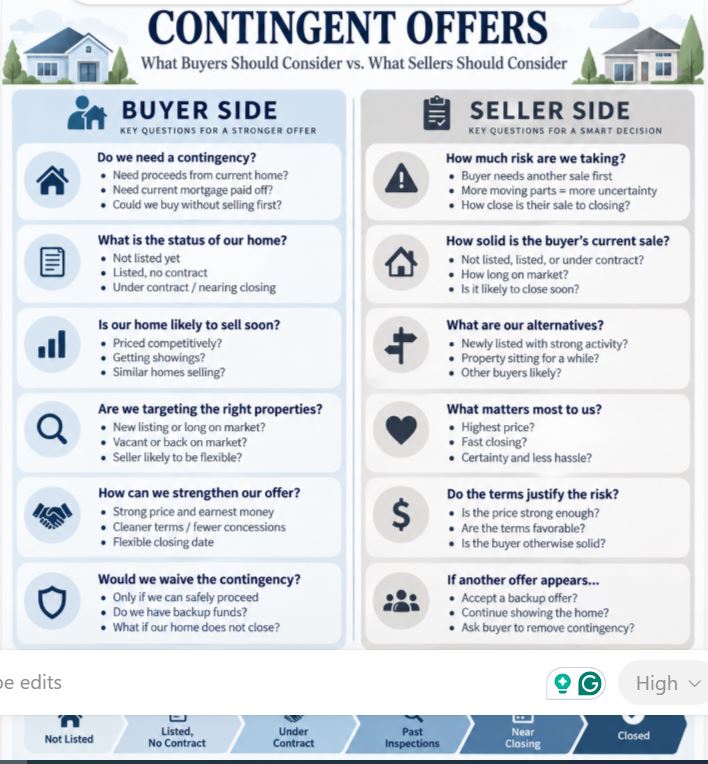
But every protection given to one side of a contract creates something for the other side to evaluate. From the seller’s perspective, the transaction now depends not only upon you successfully purchasing their property. It also depends upon another property selling first.
And that difference becomes very important when your current house is merely listed for sale versus already being under contract.
Does Accepting a Contingent Offer Take the Seller Completely Off the Market?
Not necessarily. The Texas contingency addendum gives sellers an important protection.
A seller who has accepted an offer contingent upon the buyer’s sale of another property can still receive and negotiate other offers. If another acceptable offer appears and is properly placed in back-up position, the seller may be able to require the first buyer to make a decision within the period established in the original addendum: waive the sale-of-property contingency or allow the first contract to terminate.
That mechanism is commonly described as a kick-out provision. The distinction is important because sellers sometimes assume that accepting a contingent offer means they must simply sit and wait indefinitely to see whether the buyer’s house sells. That is not necessarily the case. However, accepting a contingent contract is still not exactly the same as remaining completely available.
Once a property already has a primary contract, even a contingent one, some prospective buyers will still pursue it and submit back-up offers. Others will simply move on to properties where they can immediately become the primary buyer. So a contingent contract does not necessarily remove the property from consideration by every other buyer, but it does change the property’s competitive position.
The Kick-Out Decision Can Be Difficult for the Buyer Too
Suppose another acceptable buyer appears. The original buyer may now face a choice: waive the contingency or lose the house. That decision should not be taken casually. If buyers truly need the proceeds from their existing house in order to complete the next purchase, waiving the contingency can dramatically increase their risk.
Before waiver, failure of the other sale may provide protection under the contingency. After waiver, failure of the other property to close may no longer provide the same protection. For that reason, a buyer should not waive a contingency simply because another offer has appeared and emotions are running high.
A contingency should be removed because the buyer can safely proceed without it—not merely because the buyer is afraid of losing the house.
“Our House Is Already Listed” vs. “We Are Pending Closing”.
From the seller’s perspective, however, 2 different offers contingent on the sale of another property carry very different levels of uncertainty.
| Where the buyer’s current home stands | How the seller is likely to view the risk |
|---|---|
| Not yet listed | Very high uncertainty |
| Listed, but no buyer yet | High uncertainty |
| Listed for an extended period without selling | High uncertainty, with additional questions about price and marketability |
| Under contract but early in the transaction | Considerably better, although that contract can still terminate |
| Under contract and through major early contingencies | Stronger |
| Approaching closing | Much stronger |
| Already closed | The home-sale contingency may no longer be necessary |
This is why saying, “But our house is already on the market,” does not completely answer the seller’s concern.
The seller wants to know how close that house actually is to producing the money needed for this purchase.
The Strongest Contingent Offer Is Usually One Moving Toward Closing
As the buyer’s current transaction progresses, the contingency generally becomes easier for the next seller to evaluate. Once the buyer has accepted an offer on the current property, one major uncertainty has disappeared. Once inspections are completed, another has diminished. Once appraisal and financing are substantially complete, the chain becomes more predictable. As closing approaches, the home-sale contingency begins to look less like an open-ended possibility and more like a timing issue.
This is why buyers do not necessarily have to choose between two extremes: “Do absolutely nothing until the current house closes.” or “Make offers everywhere immediately.”
There is a continuum. The buyer’s negotiating position can improve dramatically as the existing sale progresses.
Why a Newly Listed Seller May Have Very Little Reason to Accept That Risk
Now imagine the seller on the other side has only been on the market for 10 days. Their listing is new. They have showings scheduled. An open house is coming. Several agents have requested information. The seller does not yet know whether they will receive one offer, five offers or no offers at all.
Then we arrive and say: “We would like to buy your house, but we first need someone to buy ours.”
The seller may reasonably decide to wait. They could possibly say: Why tie themselves contractually to a transaction dependent upon another unsold property when they haven’t even had enough time to discover what the rest of the market may offer?
That doesn’t mean no newly listed seller will ever accept a home-sale contingency. A sufficiently attractive price or other favorable terms can change the calculation. The seller’s personal circumstances may also make certainty today more valuable than waiting for another buyer tomorrow.
But generally, the more alternatives the seller believes they have, the less appealing additional uncertainty becomes.
Compare it with a more motivated seller.
Perhaps the same property has already been on the market for 90 days. Perhaps the seller has moved and is carrying two houses. Maybe another transaction fell apart. Maybe activity has slowed. Perhaps the seller is more concerned with achieving a particular price than closing as quickly as possible. Or perhaps our offer is simply strong enough in other areas that the seller believes the extra risk is worthwhile.
In other words, at that point, the same risk-and-reward calculation now makes sense for them.
That is why one strategy for a buyer who needs a home-sale contingency is to look particularly carefully at homes that have already had some exposure to the market. A home that has been available for 60, 90 or 120 days may present a very different negotiation opportunity from the attractive new listing that appeared a few days ago.
What Makes a Seller More Likely to Accept a Contingent Offer?
There is no single formula, because every seller values different things.
One seller may care primarily about price. Another may care about closing before a relocation date. Another may want a leaseback. Someone carrying an empty property may value certainty and speed more than squeezing out the last few thousand dollars.
This is why an offer should be viewed as a package rather than a single number. A seller may be more willing to tolerate a home-sale contingency when other components of the offer are strong: price, financing, earnest money, requested concessions, closing date (if it can be determined), possession terms and the apparent probability that the buyer’s existing property will actually close.
The most important step is not disguising the contingency. It is reducing the uncertainty surrounding it. If the buyer’s current property is already under contract, that information matters. If inspections are complete, that matters. If the appraisal is finished, that matters. If financing is progressing and the closing date is approaching, the seller can evaluate the risk very differently. When the current property is merely listed, its marketability becomes important. A realistically priced home receiving strong showing activity presents a different picture from a property that has spent months on the market without attracting serious interest.
The stronger and more predictable the buyer’s existing sale becomes, the easier the contingency becomes for the next seller to accept.