

Rent-to-Own: A Strategy That Could Work For Some Home Sellers in DFW
September 9, 2026
by Elena Garrett, Realtor – Sept 2026
Sometimes a homeowner is ready to move, the house has been prepared for sale, and the plan seems straightforward: sell the property and move on. But the market does not always cooperate with the seller’s timeline. Maybe the offers that came in were lower than expected. Maybe reducing the price further would have meant giving up too much equity. Maybe the amount still owed on the property made a substantial price reduction difficult. Or maybe the right buyer simply did not appear while the seller still needed to move.
In situations like that, there may be another way to keep working toward the same goal: sell the house, just on a longer timeline. That is where rent-to-own can sometimes come into the picture.
The basic idea is much simpler than it sounds. Instead of finding a buyer who can purchase the house with a mortgage today (which would have been ideal, but the market is not delivering an immediate buyer, apparently), the seller finds someone who wants the house now but needs additional time before they can qualify for financing. The future buyer moves into the property, the parties agree on the intended purchase terms, and the buyer spends the next several months working toward mortgage qualification.
If everything goes according to plan, the process does not end with the occupant packing up and leaving. It ends with that occupant purchasing the house.
That is the key idea to keep in mind throughout this article: the goal is still the sale. The timeline is simply different.
Before we get into contracts, deposits, inspections, or the Texas rules that apply, let’s first make sure the basic structure is clear and then walk through what the process actually looks like from beginning to end.
A Simple Overview of How Rent-to-Own Works
What Rent-to-Own Really Is
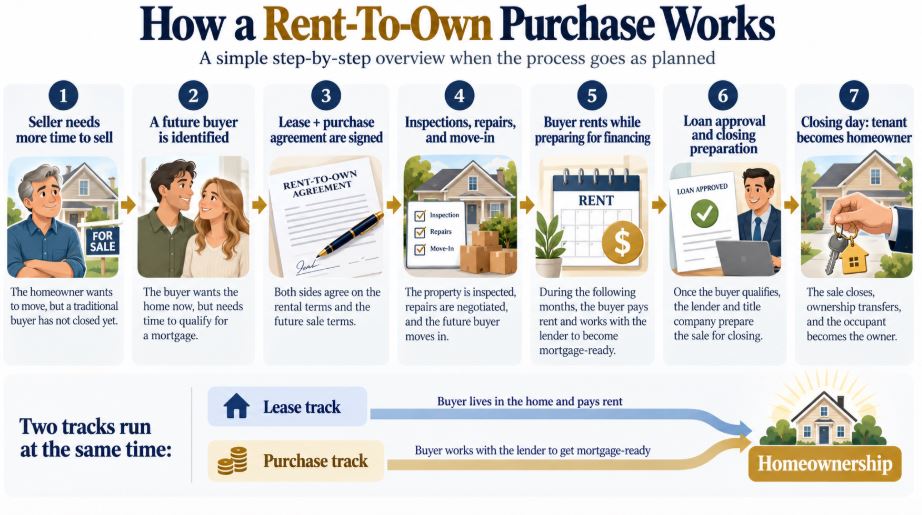
A rent-to-own transaction is essentially a sale with a delayed closing. The seller and future buyer agree today on the terms under which the buyer intends to purchase the home later. In the meantime, the buyer moves into the property and lives there while working toward mortgage qualification.
15 Steps To Selling Your Home With Rent-to-Own in Texas
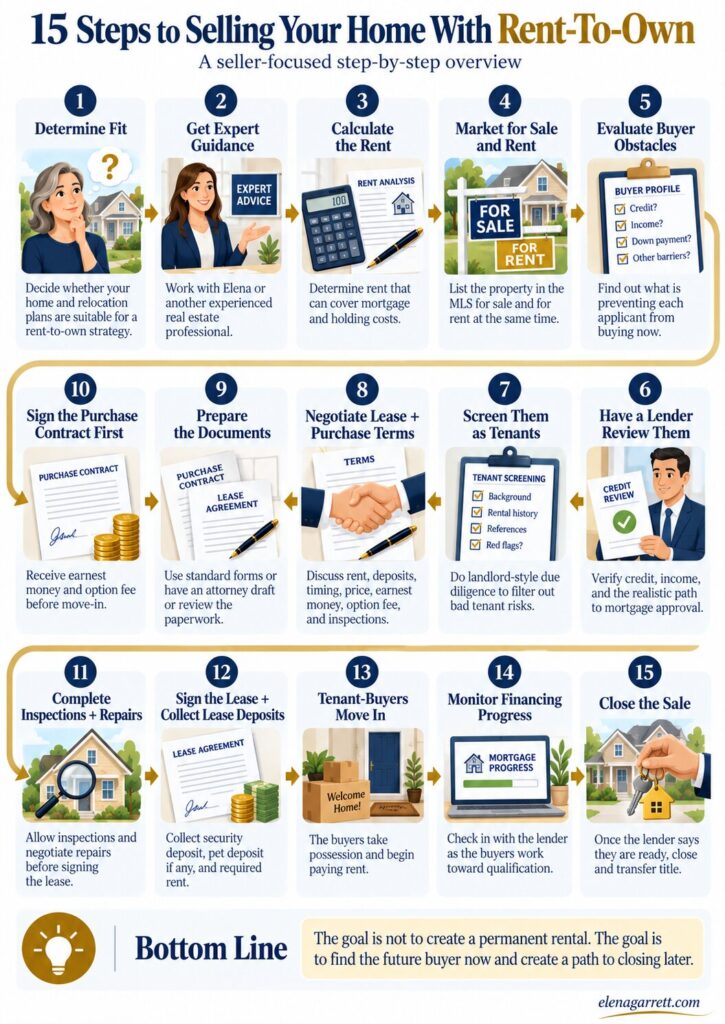
So how does the rent-to-own sale actually work in Texas?
Here are the 15 steps to selling your home with a rent-to-own strategy.
Step 1: Determine Whether Your Home Is a Good Fit for Rent-to-Own
Not every seller and not every property is a good candidate for this strategy. Start by looking at your sale and relocation plans. How quickly do you need the property completely sold? How long can you realistically continue owning it? And what is the maximum amount of time you would be comfortable having future buyers living in the property before they are ready to close?
This is a good conversation to have with me, or with another real estate professional experienced with rent-to-own transactions, because this is a longer-term sales strategy. Ideally, the rent during that period should cover most or all of your mortgage and other holding expenses.
Step 2: Work With an Experienced Real Estate Professional
Rent-to-own involves both a rental transaction and a future home sale.
You want someone helping you who understands how those two sides interact, how to market the property, how to screen potential buyers, and when additional legal or lending guidance is needed.
I can guide homeowners located in the Dallas – Fort Worth area through this process. If you are located in a different part of Texas, reach out to me and see if I can refer you to a local realtor.
Step 3: Determine the Rent You Will Need To Cover Your Holding Expenses
Before advertising the property, calculate what it will actually cost you to continue owning the house after you move out. Look at your mortgage payment, property taxes, insurance, HOA expenses, expected maintenance, and other carrying costs. Then determine what monthly rent would make the strategy financially workable for you.
Your rent does not need to match the market rents in the area. But it is best, if it is not too drastically different, either.
Step 4: Market the Property for Sale and for Rent
The property can be marketed for both possibilities at the same time. Elena would typically use two separate MLS listings:
- one offering the property for sale,
- and another offering it for rent.
That allows us to continue looking for a traditional buyer who can close now while also attracting potential rent-to-own candidates.
Step 5: Find Out Why Each Potential Buyer Cannot Purchase Today
Once rent-to-own applicants begin showing interest, the most important question is: What is stopping this person from buying the house right now? And then: How long will it realistically take to fix that problem?
A trusted lender should review the buyer’s current credit, income, debts, employment, available funds, and expected loan amount. We want to know whether there is a realistic path from where they are today to being able to purchase your home at the agreed price.
Step 6: Screen Them as Tenants
Even though the goal is for these people to eventually purchase the house, they will first be living there as tenants. So we still perform the kind of due diligence a careful landlord would normally use. The goal is to screen out applicants who may present unacceptable rental risk before they ever move into the property.
Step 7: Negotiate Both the Lease Terms and the Purchase Terms
Now we start putting the actual deal together.
On the rental side, we discuss things such as the monthly rent, security deposits, pet deposits or fees, lease duration, renewal possibilities, and other lease terms.
On the sale side, we discuss the purchase price, earnest money, option fee, financing, inspection period, future closing date, and other terms of the purchase.
Step 8: Decide How the Documents Will Be Prepared
Depending on the transaction, we may use the applicable standard Texas lease and purchase forms. If the seller wants customized provisions or the situation is more complicated, a Texas real estate attorney may prepare or review the documents instead. The more customized the relationship becomes, the more valuable a paid lawyer guidance can be.
Step 9: Sign the Purchase Contract First
I recommend establishing the sale before beginning the rental relationship. The future buyer signs the purchase agreement and delivers the purchase-side funds, such as earnest money and the option fee, according to the contract. Now, there is an actual planned home sale in place.
Step 10: Complete the Home Inspection Before Move-In
Before the future buyer becomes a tenant, give them the opportunity to inspect the house. They can perform their normal due diligence, identify property-condition concerns, and request repairs just as they might in a traditional home purchase. The seller and buyer can then negotiate those issues before anyone moves in.
I recommend dealing with home inspection disagreements now than discover them after the buyer is already occupying the house.
Step 11: Sign the Lease and Collect the Lease-Side Deposits
Once the inspection period is complete and both sides are comfortable moving forward, the lease can be signed. The seller receives the applicable lease-side funds, such as the security deposit, pet deposit if applicable, and rent required before move-in.
The future buyer can then take possession of the property.
Step 12: The Tenant-Buyers Move In and Begin Paying Rent
The rental period now begins. The future buyers live in the house and make their agreed monthly rent payments while continuing to work toward mortgage qualification. The seller remains the owner of the property during this period.
Step 13: Monitor Their Progress With the Lender
Do not simply sign everything and disappear for twelve months. Periodically check in with the buyer’s lender.
Are they improving their credit? Are they reducing the debts they needed to reduce? Are they meeting the employment or income requirements?
The purpose of this waiting period is to move steadily toward a mortgage—not simply to wait for time to pass.
Step 14: The Lender Announces That the Buyers Are Ready
At some point during the lease, ideally the lender says: They are now qualified to purchase the house.
That is the milestone everyone has been working toward. Now the delayed sale begins moving toward its final closing.
Step 15: Close the Sale
The lender and title company prepare the necessary closing documents. The lender finalizes the mortgage. The title company coordinates the closing, payoff of the seller’s existing mortgage, and the final accounting of the transaction.
Then everyone signs and the ownership transfers to the buyers. The seller receives the proceeds from the sale. And the people who originally moved into the property as tenants become the homeowners.
What Documents Are Involved
There are usually two main sets of documents:
- A lease, which governs the period while the buyer is living in the home.
- A purchase agreement, which governs the future sale.
The lease deals with things such as rent, deposits, maintenance, and early termination. The purchase agreement deals with the sales price, inspections, earnest money, financing, and the future closing date.
What the Typical Timeline Looks Like
The process usually begins with a lender reviewing the future buyer’s finances to determine whether the expected timeline for mortgage qualification is realistic.
The parties then agree on the basic terms, sign the appropriate documents, complete inspections, negotiate any repairs, and prepare for move-in.
During the following months, the buyer works toward qualifying for the mortgage. If everything goes according to plan, the process ends with a regular real estate closing and the occupant becomes the owner.
What Gives the Seller Some Protection
There is never a guarantee that the future purchase will happen, but several things can reduce the risk.
The future buyer can be reviewed by a lender before the agreement begins. The buyer can put earnest money toward the purchase. The buyer must also comply with both the lease and the purchase agreement while the transaction is in progress.
The seller may also be able to accept a backup offer if another buyer becomes interested, while still honoring the first buyer’s existing contract rights.
What Each Side Is Responsible For
The seller must honor the lease and the purchase agreement while they remain in effect.
The buyer must pay rent, follow the lease, work toward financing, and meet the requirements of the purchase agreement.
If either side wants to terminate, extend, or change the arrangement, the applicable agreement determines what can happen next.
If They Are Renting the House, How Is This Still a Sale?
In a regular rental, the homeowner finds a tenant, signs a lease, collects rent, and hopes to find a buyer sometime in the future. The tenant has no particular obligation or plan to purchase the property.
In a rent-to-own transaction, the people moving into the house are also entering into an agreement to purchase it. The important elements of the future sale are established from the beginning.
The parties may agree on:
- the purchase price;
- the future closing date;
- earnest money toward the purchase;
- inspection and repair negotiations;
- financing requirements;
- and the other terms of the future sale.
So the seller is not simply saying, “I will rent my house for a year and then see what happens.”
The arrangement is closer to:
“I have found the people who intend to buy my house. They need additional time before they can obtain the mortgage, so they will occupy the property under a lease while we work toward the already-planned closing.”
That distinction is important.
What Makes It Different From an Ordinary Rental?
With rent-to-own:
Future buyer is identified → purchase terms are established → buyer moves in temporarily → buyer works toward financing → planned sale closes.
The lease is not intended to replace the sale. It is the bridge between today and the future closing.
Is the Sale Guaranteed?
No. The future buyer may ultimately fail to obtain financing, circumstances may change, or one of the agreements may terminate according to its terms. That is why a rent-to-own transaction needs protections for both sides. But unlike an ordinary rental, the seller begins the process with an identified prospective purchaser, agreed purchase terms, and a specific plan for reaching a future closing.
So What Actually Exists During That Waiting Period?
Once that basic distinction is clear, the rest becomes much easier to understand. There are essentially two relationships operating at the same time:
The lease controls the period while the future buyer is living in the house.
The purchase agreement controls the planned sale of the house.
The next step is understanding how those two pieces work together.
What Should I Consider Before Entering a Rent-to-Own Agreement?
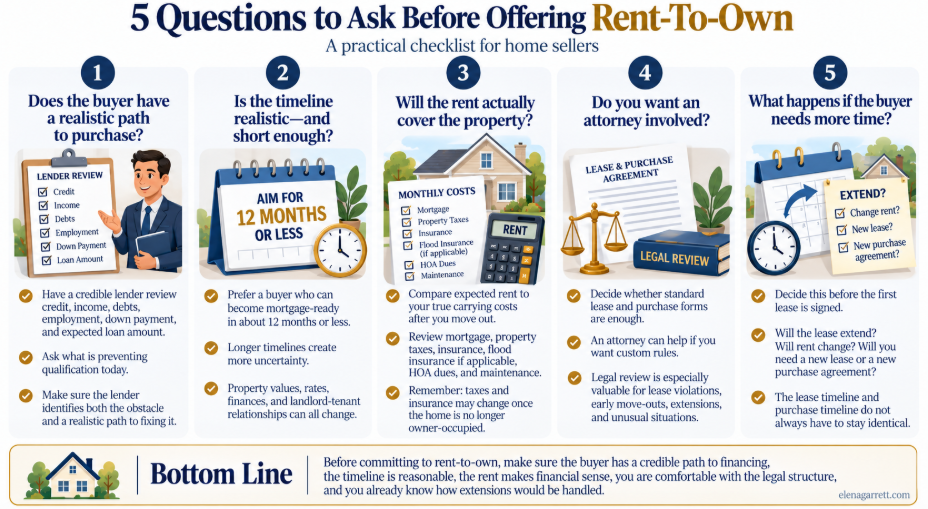
Before committing your property to a future buyer, I would focus on a handful of major questions.
1. Does This Buyer Have a Realistic Path to Purchasing the House?
Before taking the property off the market, have a credible lender evaluate the future buyer’s credit, income, debts, employment, available down payment, and expected loan amount. The important question is not simply whether they want to buy the house, but what is preventing them from qualifying today and whether that problem can realistically be solved within the proposed timeframe.
Ideally, the lender should be able to identify both the obstacle and a reasonable path toward correcting it.
2. Is the Timeline Realistic—and Short Enough?
My preference is generally to enter into the actual purchase agreement when the buyer appears capable of becoming mortgage-qualified within approximately 12 months or less.
The farther into the future you lock in a sale, the more things can change: property values, interest rates, the buyer’s finances, your own plans, and even how well the landlord-tenant relationship works. A twelve-month commitment already requires both parties to make assumptions about the future. A two- or three-year commitment requires considerably more.
3. Will the Monthly Rent Actually Help Me Carry the Property?
Do the math before committing. Compare the expected rent with your actual monthly carrying costs after you move out, and do not automatically use what the house costs you today. Some expenses may change once the property is no longer owner-occupied.
Review the mortgage payment, property taxes, homeowner or landlord insurance, flood insurance if applicable, HOA dues and assessments, and expected maintenance costs. Insurance can change when an owner-occupied house becomes tenant-occupied, and property taxes may also change if moving out affects exemptions or other tax treatment.
So before deciding that, for example, $2,200 in rent will cover the house, first determine what the house will actually cost you after you leave it.
4. Do I Want an Attorney Involved?
This is an important practical decision because legal review costs money. One approach is to rely primarily on the standard lease and purchase forms and their existing provisions where appropriate. The other is to hire a Texas real estate attorney to review the overall structure and, where legally appropriate, address how the lease and purchase relationship should interact.
The attorney becomes particularly valuable if you want special provisions dealing with what happens to the purchase agreement after a serious lease violation, what happens if the tenant leaves early, how extensions should work, or how other unusual circumstances should affect the two agreements. The more customized you want the arrangement to be, the more important legal guidance becomes.
5. What Happens If They Need More Time?
This should be considered before the first lease is signed. Suppose the buyer reaches month eleven and the lender says, “You are very close, but you need another six months.”
Will you allow them to remain? Will the lease automatically extend? Will you require a new lease? Will the rent change? Will you extend the purchase closing date, or will the original purchase agreement end and a new agreement need to be negotiated?
Those are very different decisions. You may be comfortable allowing the tenant to stay for a second year while continuing to work toward financing, but that does not necessarily mean you want to remain locked into the original sales price for another year.
This is another reason the lease timeline and purchase timeline do not necessarily have to be identical forever. Before entering the transaction, decide how much additional time you would potentially be willing to give and under what circumstances.
The Bottom Line
Before saying yes to rent-to-own, I would want the homeowner to be comfortable with five things: the buyer has a credible path to financing, the expected timeline is reasonable, the rent makes sense compared with the homeowner’s new post-move expenses, the homeowner has decided whether the standard documents are sufficient or whether attorney involvement is worth the additional cost, and there is a plan for what happens if the buyer needs more time.
If those questions have good answers, then it makes sense to begin examining the actual transaction in greater detail.
How Do I Know They Will Actually Buy?
There is no way to guarantee that a future buyer will successfully purchase the house a year from now. Jobs change, credit changes, relationships change, and sometimes financing simply does not come together. The goal is not to pretend that risk does not exist. The goal is to make the arrangement very different from an ordinary rental by choosing people who have both a financial commitment and a strong reason to stay.
They Have More Money at Stake Than a Regular Tenant
A normal tenant may move in with a security deposit and the first month’s rent. A rent-to-own buyer may have those same rental obligations plus money committed to the future purchase.
For example, the rent-to-own buyer might provide:
- a rental security deposit under the lease;
- earnest money connected with the purchase agreement;
- and, depending on the contract, an option fee or other purchase-related funds.
Those amounts serve different legal purposes, but from the homeowner’s point of view there is an important practical difference: the occupants have substantially more invested in the transaction than someone who simply rented the house for twelve months.
If they abandon the purchase, they may place some of that purchase-related money at risk depending on the terms of their contract. That gives them a financial reason to take the purchase seriously.
They Chose the House Because They Hope to Keep It
There is also a major difference in motivation.
A regular tenant knows from the beginning that the house belongs to somebody else. They may plan to stay one year, two years, or perhaps even less.
A rent-to-own buyer is moving into a house they hope will become their own home.
They may already be thinking about where their furniture will stay, which bedroom belongs to which child, what they eventually want to change in the backyard, and what the house will look like several years from now.
That does not guarantee perfect behavior, but it creates a very different incentive.
Someone who believes, “I may be buying this house next year,” has much more reason to care about its condition than someone who already expects to hand the keys back at the end of the lease.
Their Goal Is Usually Not to Move Again
This is another reason rent-to-own can be attractive to a seller who is worried about ordinary tenant turnover.
The future buyer is generally choosing rent-to-own precisely because they do not want another temporary home.
They may be willing to move now because they believe this is the house they want to purchase later. If the plan works, there is no move-out, no vacancy between tenants, no new rental listing, and no need to prepare the property for another occupant.
The person who moved in simply becomes the owner.
We Still Screen Them Carefully
None of this means that we accept anyone who says, “I would like to buy your house someday.”
Before the agreement begins, the future buyer should be evaluated much more seriously than that.
Ideally, a lender reviews their credit, income, debts, available down payment, and the reason they cannot qualify today. We want to know whether there is a realistic path to mortgage approval, not just a hopeful one.
The stronger the buyer’s financial plan, the money they have invested in the transaction, and their desire to remain in the home, the less the arrangement resembles an ordinary rental.
That is the protection we are trying to build: not a promise that nothing can go wrong, but a future buyer who has more to gain by completing the purchase—and more to lose by simply walking away.
How Long Does Rent-to-Own Usually Take?
There is no magic timeline. A rent-to-own arrangement might be structured for six months, twelve months, eighteen months, or longer depending on what is preventing the future buyer from obtaining a mortgage today.
For many transactions, about one year is a practical starting point—but I would not choose twelve months simply because it sounds convenient. The timeline should be based on the buyer’s actual financial situation.
If the lender says, “They need another tax return,” “They need twelve months of employment history,” or “They need time to reduce these particular debts,” we can build the timeline around that requirement. If the lender believes the problem will realistically take eighteen months to correct, writing a twelve-month agreement only creates trouble later.
How Do We Avoid Surprises at the End?
The goal is to discover as many potential problems as possible before the future buyer moves in, rather than waiting until the planned closing.
That means checking several things early:
- Financing: Have a lender review the buyer’s credit, income, debts, down payment, and realistic mortgage timeline.
- Property condition: Complete inspections and negotiate major repairs before move-in.
- Title: Make sure there are no unexpected ownership, lien, or title issues that could interfere with a future sale.
- Insurance and existing mortgage: The homeowner should verify how moving out and renting the property affects insurance coverage and any relevant loan requirements.
- Purchase price and appraisal risk: Remember that the future lender will still need the property to support the loan when closing approaches.
- Progress during the year: The future buyer should stay in contact with the lender rather than disappearing for eleven months and applying for a mortgage at the last minute.
The idea is simple: do as much of the future closing homework as we reasonably can at the beginning.
We cannot know exactly what the market, interest rates, property value, or buyer’s finances will look like a year from now. But we can avoid entering the arrangement with problems that were already discoverable today.
A good rent-to-own transaction should therefore feel less like “Let’s wait a year and see what happens” and more like “We know what needs to happen during this year, and we have a plan for getting there.”
Two Agreements Running at the Same Time
One of the easiest ways to understand rent-to-own is to think of it as two tracks running side by side toward the same goal.
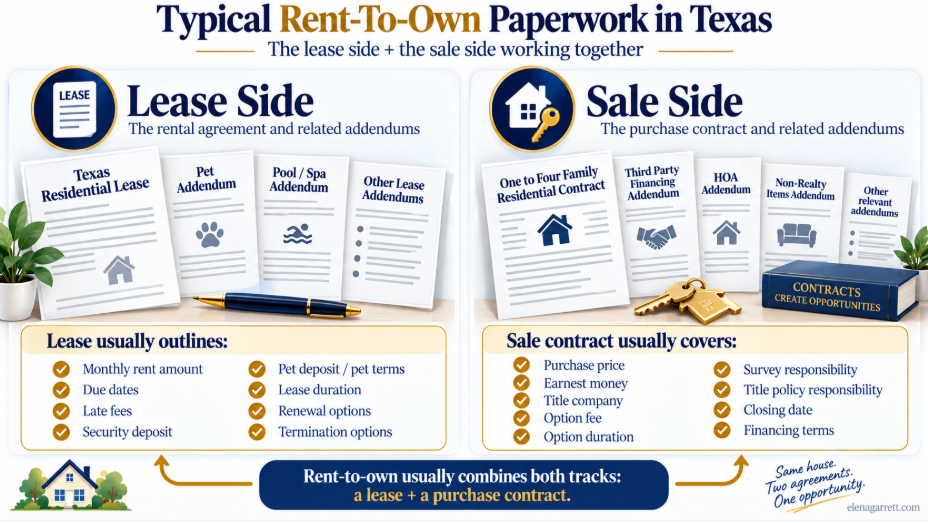
Track One: The Rental Agreement
The rental agreement controls what happens while the future buyer is living in the house.
It answers practical questions such as:
- How much is the monthly rent?
- When is it due?
- What security deposit is required?
- Who is responsible for certain maintenance?
- What happens if the tenant wants to leave early?
- What happens if rent is not paid?
For this part of the transaction, the homeowner is acting as the landlord and the future buyer is acting as the tenant.
Track Two: The Purchase Agreement
At the same time, there is a separate agreement dealing with the future sale of the house.
That agreement addresses things such as:
- the agreed purchase price,
- the future closing date,
- earnest money,
- inspections and repairs,
- financing,
- and what happens if the sale does not close.
For this part of the transaction, the homeowner is the seller and the tenant is also the future buyer.
Both Agreements Exist at the Same Time
This is the part that makes rent-to-own different from simply renting a house and hoping to sell it later.
The homeowner is not waiting until the lease ends to start looking for a buyer. The future buyer has already been identified, and the future sale is being arranged while that buyer is living in the property.
So during the same twelve-month period, the same two people may have two different relationships:
Landlord ↔ Tenant
for the temporary occupancy of the house
and
Seller ↔ Future Buyer
for the planned purchase of the house.
The two agreements deal with different responsibilities, but they are designed to move toward the same destination:
the lease eventually ends because the sale closes and the tenant becomes the homeowner.
The Sale Side Works Much Like a Regular Home Sale
For the homeowner, the easiest part of rent-to-own to understand is usually the sale side, because it can look very much like a regular home sale.
The future buyer and seller agree on the major terms of the purchase, including the sales price, closing date, earnest money, inspection period, financing terms, and any negotiated repairs. The biggest difference is simply that the closing date is much farther in the future than it would be in a typical sale.
The Purchase Price Is Agreed Upon
The seller and future buyer agree on the price at which the home is expected to be purchased.
For example, they may agree today that the future sale price will be $350,000, with closing scheduled approximately one year later.
That gives both sides a clear target from the beginning.
The Buyer Makes an Earnest Money Deposit
Just like in a regular home purchase, the buyer may deposit earnest money toward the transaction.
Earnest money is a way for the buyer to show that they are serious about completing the purchase.
It is not the same thing as the rental security deposit. The security deposit belongs to the lease side of the arrangement. Earnest money belongs to the purchase side.
The purchase contract determines what happens to that earnest money if the transaction closes, if the buyer properly terminates, or if one of the parties later defaults.
The Buyer Can Have an Option Period
The purchase agreement can also include an option period, just like a traditional Texas home sale.
During that period, the buyer can inspect the property and evaluate whether they are comfortable proceeding with the purchase.
For example, the parties might agree to a seven-day option period.
During those seven days, the buyer may order a professional inspection and investigate the condition of the property before becoming fully committed to moving forward.
Inspections and Repair Negotiations Still Happen
The fact that the buyer may live in the property before closing does not mean they should skip the normal inspection process.
In fact, it is even more important to address major property-condition questions before the buyer moves in.
Suppose the inspection finds:
- several fogged windows,
- an HVAC system that needs servicing,
- a masonry crack,
- and a damaged fence.
The buyer can ask the seller to address those items just as they might in a regular home sale.
The seller can agree, decline, or negotiate.
Maybe the seller agrees to repair the windows and service the HVAC system, but does not agree to replace the fence.
Once both sides agree, the negotiated repairs can be documented as part of the purchase transaction.
The Buyer Can Still Decide Not to Proceed During the Inspection Period
If the buyer discovers a serious problem during the agreed inspection and option period, they may have the right under the purchase contract to terminate the sale.
For example, if the inspection reveals a major foundation problem and the parties cannot reach an agreement, the buyer may decide not to continue.
That is one reason I prefer to complete the inspection and repair negotiations before the future buyer moves into the house.
It gives both sides the opportunity to make sure they are comfortable with the property and the purchase terms before the rental portion truly gets underway.
The Closing Date Is Simply Farther Away
In a traditional home sale, closing might be scheduled three or four weeks after the contract is signed.
In a rent-to-own arrangement, the closing date may be six months, twelve months, eighteen months, or another agreed period in the future.
That extra time is what gives the future buyer the opportunity to work toward mortgage qualification.
Otherwise, the basic goal is the same:
Buyer and seller agree on the property and price → buyer inspects the home → repairs are negotiated → financing is obtained → the transaction closes.
The sale itself is not an imaginary future promise.
It is a planned real estate transaction with a delayed closing date.
How Far Into the Future Should the Sale Be Scheduled?
Technically, a future closing can be scheduled well in advance. Practically, however, I am very cautious about asking a seller and buyer to lock themselves into a purchase agreement for too long.
My general recommendation is to use this structure when the buyer has a reasonably firm path to mortgage qualification within about 12 months or less.
Why? Because once the purchase agreement is signed, both sides have made a serious commitment to one another.
The Seller Is Committing to Today’s Deal
Suppose the seller agrees today to sell the house for $350,000.
Six months later, the market improves dramatically and similar homes are selling for $375,000. The seller cannot simply replace the existing buyer with someone willing to pay more while the original purchase contract remains in effect.
A longer contract therefore means accepting more uncertainty about what the property may be worth in the future.
The Two Sides Barely Know Each Other Yet
At the beginning, the homeowner does not really know what these future buyers will be like as tenants.
Likewise, the buyers do not yet know what the homeowner will be like as their landlord.
Most relationships may work perfectly well. Occasionally, however, two parties simply do not work particularly well together. Locking both sides into a very long purchase relationship before either has any experience dealing with the other can create unnecessary complications.
A Lot Can Change in Two Years
The farther away the closing date, the more variables we introduce.
The seller’s plans can change. The buyer’s employment, finances, family circumstances, or desire to purchase the home can change. Property values can move substantially. Interest rates and lending programs can change. Even laws and regulations can change.
A 12-month plan already asks both sides to predict quite a bit about the future. A two- or three-year commitment asks them to predict considerably more.
What If the Buyer Needs Longer Than a Year?
If the strongest prospective buyer realistically needs considerably more than twelve months before becoming mortgage-ready, I would be hesitant to lock the seller into today’s sales price and purchase agreement for that entire period.
Instead, I would explore whether it makes more sense to begin with a shorter rental commitment and preserve a future opportunity to negotiate the sale once both parties have had some experience with one another and the buyer is closer to mortgage qualification.
For example, the parties might initially establish a one-year rental period, with whatever renewal or extension provisions their attorney recommends. As the buyer gets closer to being mortgage-ready, the parties can determine whether entering into the actual purchase agreement makes sense at that point.
The precise documents matter here. In Texas, certain leases combined with purchase options can trigger special statutory rules even when the lease and purchase rights appear in separate documents, so this is an area where the structure should be reviewed by a Texas real estate attorney.
The principle, however, is simple:
If the buyer is likely to be ready within about a year, establishing the future sale now may make sense. If the realistic timeline is much longer, I would rather preserve flexibility than lock both parties into today’s assumptions for several years.
Now Let’s Look at the Lease Side
As the name suggests, rent-to-own begins with rent and ends with ownership. The sale may be the ultimate goal, but before that closing happens, the future buyer may live in the property for several months, a year, or sometimes longer. During that period, the homeowner is still the owner of the property, and the future buyer is also a tenant.
For many homeowners, this is the less familiar part of the transaction. You may already understand the basics of selling a house: purchase price, earnest money, inspections, repairs, financing, and closing. But if you have never been a landlord before, terms such as security deposits, lease terms, late fees, maintenance responsibilities, early termination, and tenant rights may be completely new.
That is why the lease deserves its own explanation. Before allowing anyone to move into the property, the homeowner needs to understand how the rental money works, what the tenant is responsible for, what the landlord is responsible for, what happens if something goes wrong, and how either party can end the rental relationship.
The good news is that the basic structure is not particularly complicated once the pieces are separated. We will start with the financial side of the lease, then look at the rules for living in the property, and finally discuss what happens if either the tenant or the landlord wants the arrangement to end before the planned purchase.
The Financial Side of the Lease
For many homeowners, one of the biggest concerns is very practical: if I move out before the house sells, how am I going to keep paying the mortgage?
This is one area where rent-to-own may compare favorably with an ordinary rental. The future buyer is not simply shopping for the cheapest place to live. They are looking for a particular house they hope to own, and rent-to-own opportunities are usually much less common than regular rentals. That can sometimes give the homeowner more flexibility when negotiating the monthly rent.
For example, if similar homes are renting for $2,000 per month but the homeowner’s carrying costs are higher, a future buyer may be willing to consider $2,150 or $2,200 because they are evaluating more than just the rental price. They are also getting the opportunity to move into the home they hope to purchase. This does not mean rent can be set arbitrarily high, but it may give the seller more room than a traditional rental would.
What Does the Future Buyer Pay Before Moving In?
The lease will normally establish several amounts that must be paid before or around move-in.
First month’s rent. This is the regular payment for occupying the property and is handled just like rent in any other lease.
Security deposit. The landlord will normally collect a security deposit to help protect against amounts for which the tenant may become responsible under the lease. This is not the same as rent and should not be mentally treated as extra income: some or all of it may eventually have to be returned. Texas law does not allow a landlord to keep a security deposit simply for ordinary wear and tear.
Pet deposit, pet fee, or pet rent. If pets are permitted, the lease may also establish additional financial terms. Depending on how the lease is written, this might include a refundable pet deposit, a separate pet fee, monthly pet rent, or some combination of these. Assistance animals are legally different from ordinary pets and generally cannot be subjected to ordinary pet deposits or pet fees under federal fair-housing rules.
What Might the Initial Cash Look Like?
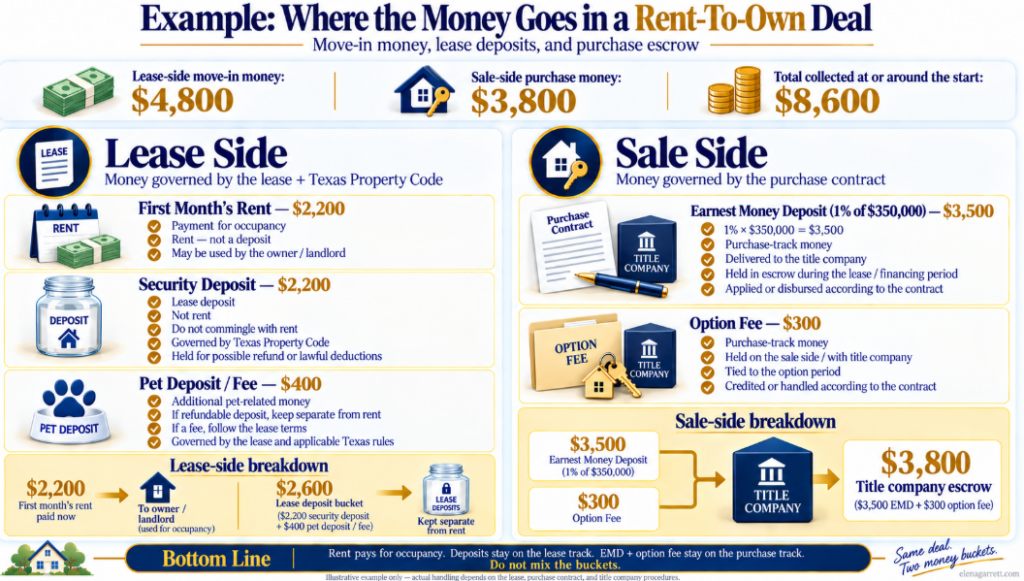
Suppose the agreed rent is $2,200 per month and the security deposit is also $2,200.
A tenant with one approved pet might also have, for example, a $400 pet deposit or fee, depending on the lease.
At move-in, the landlord might therefore receive approximately:
$2,200 — first month’s rent
$2,200 — security deposit
$400 — pet-related deposit or fee
Total paid at or around move-in: $4,800
But those dollars are not all the same.
The rent is payment for occupancy.
The security deposit remains connected to the tenant’s obligations under the lease and may eventually need to be returned.
A pet deposit may likewise remain refundable depending on how it is structured, while a clearly disclosed pet fee or monthly pet rent may be treated differently under the lease.
And Remember: Purchase Money Is Separate
At roughly the same time, the future buyer may also be putting money into the purchase side of the transaction—for example, earnest money and an option fee.
That money should not be confused with the landlord’s move-in funds.
The rental security deposit belongs to the lease relationship.
The earnest money belongs to the future sale and is generally handled through the escrow/title process according to the purchase contract.
So at the beginning of a rent-to-own transaction, the future buyer may actually be making two separate financial commitments at once:
money required to move into the house, and
money committed toward the future purchase.
That is one of the reasons a properly structured rent-to-own transaction can feel very different from placing the property into an ordinary rental.
What Happens If the Lease Ends Early?
A lease may end earlier than originally planned. The tenant may have an early-termination right under the lease, the parties may mutually agree to end it, or Texas law may provide a termination right in certain circumstances. A tenant may also simply leave in violation of the lease; in that situation, the lease and Texas law determine what the tenant may still owe, and Texas requires a landlord to make reasonable efforts to mitigate damages rather than simply allowing unpaid rent to accumulate indefinitely.
But with rent-to-own, there is an additional question:
What Happens to the Purchase Contract?
This is where remembering the two-track structure becomes important.
Ending the lease does not automatically mean the purchase agreement disappears. Likewise, ending the purchase agreement does not necessarily terminate the lease.
For example, a future buyer could move out six months early and still technically have an existing agreement to purchase the house later unless the purchase agreement has also been properly terminated.
That is why the two agreements need to be coordinated from the beginning. Before signing, the parties should understand what is supposed to happen to the purchase arrangement if the rental relationship ends early, and the attorney preparing or reviewing the transaction should make sure the documents accomplish that result.
The important rule for the homeowner is simple:
Never assume that terminating one side of the transaction automatically terminates the other.
What Happens to All the Deposits?
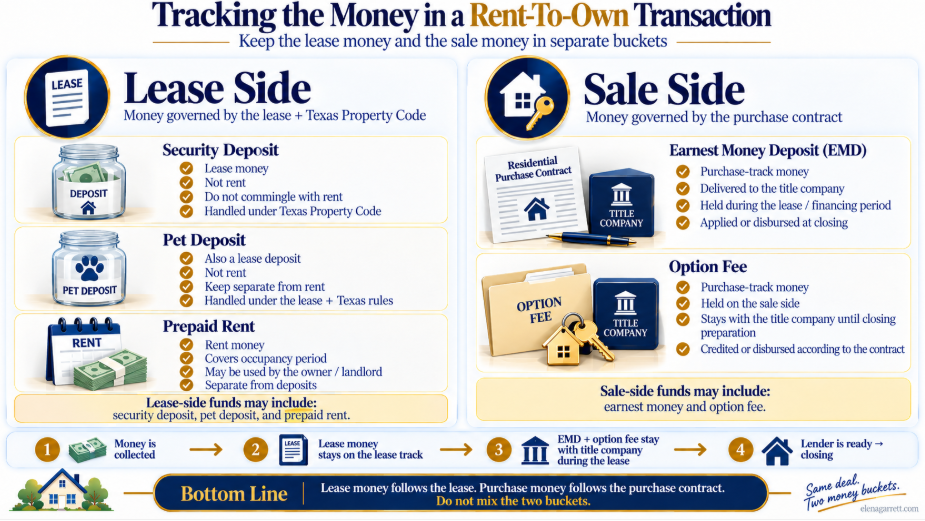
It helps to think of the money as being kept in two separate buckets.
Bucket #1: Money Connected With the Lease
This can include:
- the security deposit;
- a refundable pet deposit, if applicable;
- and any other deposits specifically created under the lease.
These funds belong to the rental side of the transaction.
Bucket #2: Money Connected With the Purchase
This can include:
- earnest money;
- an option fee;
- and any other funds required under the purchase agreement.
These funds belong to the sale side.
Keeping those two buckets separate prevents a great deal of confusion later.
If the Buyer Successfully Purchases the House
If the transaction closes, the earnest money is handled through the purchase transaction and credited according to the purchase contract. Under the standard Texas resale contract, the option fee is also credited to the sales price at closing.
The rental security deposit does not automatically become part of the down payment. The lease and closing arrangements need to specify how it will be accounted for when the tenant becomes the owner. It might be refunded or, if appropriately documented, accounted for through the closing process.
The important point is that the homeowner should not simply treat the security deposit as additional sale proceeds.
If the Purchase Does Not Happen and the Tenant Moves Out
Then the two buckets are handled separately.
The security deposit is handled under the lease and Texas landlord-tenant law. Texas generally requires a residential security deposit to be refunded within 30 days after the tenant surrenders the property, subject to lawful deductions and the rules concerning the tenant’s forwarding address.
The earnest money is handled according to the purchase contract. Depending on why the transaction ended and what termination rights still existed, the buyer may be entitled to have the earnest money returned—or the earnest money may be at risk because the buyer defaulted. There is no universal rule that says, “The mortgage failed, therefore the seller automatically keeps the earnest money.” TREC specifically notes that termination rights come from the contract itself.
The option fee is different again. In a typical Texas purchase contract, it is the consideration paid for the buyer’s unrestricted termination period. If the buyer properly uses that option period to terminate, the option fee is generally not returned, while earnest money may be refundable.
The Simplest Way to Remember It
Lease money follows the lease.
Purchase money follows the purchase contract.
And if one of those agreements ends before the other, do not assume that all of the other rights, obligations, and money automatically disappear with it.
What Happens If the Tenant Violates the Lease?
This is one of the more complicated parts of rent-to-own because, remember, two agreements are running at the same time.
Suppose the future buyer stops paying rent, brings unauthorized occupants into the property, repeatedly violates HOA rules, keeps prohibited pets, damages the house, or otherwise seriously violates the lease. The homeowner can use the remedies available under the lease and Texas landlord-tenant law. Depending on the violation and circumstances, that can eventually include requiring the tenant to leave the property.
But there is an important complication:
Ending the Lease Does Not Automatically End the Purchase Contract
The lease and the purchase agreement are addressing two different relationships.
The lease says:
“You have the right to live in my house under these conditions.”
The purchase agreement says:
“I have agreed to sell you this house under these conditions.”
A violation of the first agreement does not necessarily create a right to terminate the second agreement.
That can create an awkward situation. Imagine that the homeowner has legally ended the tenant’s right to occupy the property because of serious lease violations, but the tenant still has an existing contract to purchase the house six months later.
The homeowner should not simply assume:
“I evicted them, therefore their purchase contract is gone too.”
Whether and how those two relationships can be tied together is a legal drafting question.
This Is Another Reason I Prefer Shorter Timelines
This is one of the reasons I generally prefer a rent-to-own purchase timeline of about twelve months or less.
When the agreements are first signed, neither side really knows the other.
The homeowner does not yet know whether the future buyer will pay consistently, care for the property, follow the lease, or be easy to work with.
The future buyer likewise does not yet know how the homeowner will perform as a landlord.
The longer both sides are contractually connected, the greater the opportunity for disagreements or changing circumstances.
A twelve-month relationship already requires some trust. I would be very cautious about locking both sides into a purchase agreement several years into the future before they have any experience dealing with one another.
Can We Simply Say That a Lease Violation Cancels the Sale?
This is where I would stop trying to solve the problem ourselves.
It may sound easy to add a sentence saying:
“If the tenant violates the lease, the purchase contract automatically terminates.”
But Texas law can treat certain residential lease-and-purchase arrangements as specially regulated real estate transactions, and Texas imposes specific notice and cure requirements in some of those situations.
For that reason, coordinating a lease default with termination rights under the purchase agreement is something I would want a Texas real estate attorney to structure, rather than trying to create our own cross-default language.
The practical lesson for the homeowner is much simpler:
A serious lease violation may allow you to end the rental relationship, but do not assume that it automatically releases you from the separate agreement to sell the house.
That interaction needs to be addressed correctly when the transaction is created.
And that is another reason to avoid unnecessarily long rent-to-own purchase contracts. The shorter and more realistic the road to closing, the less time there is for the two relationships to become complicated.
What Happens When Everything Works and They Are Ready to Buy?
This is the outcome everyone has been working toward.
The tenants have completed their rental period, followed their lender’s plan, and are now ready to obtain the mortgage and purchase the house. At this point, the transaction begins to look very much like any other home sale.
The Lender and Title Company Take Over the Closing Process
Once the buyers are ready for final mortgage approval, their lender will coordinate with the title company that has been handling the purchase transaction and holding the earnest money.
The title company begins preparing for closing, including updating the title work, coordinating with the lender, obtaining any necessary payoff information from the seller’s mortgage company, and preparing the documents and financial figures needed for the sale.
From the homeowner’s perspective, this should feel familiar: you are now preparing for a normal real estate closing.
The Buyer Gets Credit for the Money Already Put Into the Purchase
Remember the earnest money the buyers deposited when the purchase agreement was originally signed?
That money has not disappeared. It is accounted for as part of the buyer’s funds in the closing transaction. The option fee is also credited toward the sales price under the standard Texas resale contract. So if the buyers deposited earnest money and paid an option fee at the beginning of the transaction, those amounts are reflected in the final closing figures rather than requiring the buyers to pay the same dollars again.
The exact amount the buyers still need to bring to closing—their cash to close—will ultimately be calculated by the lender and title company.
Now We Deal With the Rental Deposits Separately
The rental security deposit belongs to the lease side of the transaction, not the purchase side.
Once the sale has successfully closed and the landlord-tenant relationship has ended, the homeowner should be prepared to account for and return any refundable lease deposits according to the lease and applicable law, unless the parties and closing professionals have properly arranged for those funds to be handled another way.
The important thing is not to casually combine the security deposit with the purchase proceeds.
Purchase money follows the purchase transaction.
Rental deposits follow the lease.
Then You Proceed With a Normal Closing
From there, everything looks much like the closing the homeowner originally hoped to have.
The lender funds the buyer’s mortgage. The title company handles the closing. The seller’s existing mortgage and other closing obligations are paid as appropriate. The seller receives the remaining proceeds from the sale. Ownership transfers to the buyers.
And there is one pleasant difference from a traditional closing: the buyers do not need to schedule movers or wait for possession.
They are already home.
The lease has served its purpose, the delayed sale has reached its destination, and the tenants become the homeowners.
What If They Decide Not to Buy the House?
Not every rent-to-own transaction will end in a purchase. The future buyer’s circumstances may change, they may decide not to proceed, or they may simply fail to become mortgage-qualified by the planned closing date.
If that happens, we unwind the sale side and the rental side separately.
What Happens to the Earnest Money and Option Fee?
This depends heavily on the financing protections written into the purchase contract.
When the contract is originally prepared, the buyer is usually given a certain number of days to obtain financing approval. If the buyer cannot obtain approval and properly terminates within that protected period, the contract may allow the earnest money to be returned.
But once that financing-approval period has expired, the situation changes. Under the standard Texas financing addendum, if the buyer does not terminate within the agreed financing period and later cannot obtain the loan, the buyer may be in default if no other contractual right to terminate remains. In that situation, the buyer will most likely place the earnest money at risk.
The option fee is different. It was paid for the buyer’s original unrestricted termination period and generally is not refundable merely because the purchase ultimately fails.
So, depending on how the purchase contract was structured and why the transaction failed, the seller may ultimately receive the earnest money as well as retain the option fee.
That is one reason the financing timeline deserves careful thought when the original purchase agreement is written.
What Happens to the Rental Security Deposit?
That money stays on the lease side.
The homeowner should not immediately distribute the security deposit simply because the purchase contract has ended. First, the tenants need to surrender the property so the homeowner can determine its condition.
Once they move out, the homeowner can inspect the house and determine whether there are legitimate charges under the lease—for example, unpaid amounts or tenant-caused damage.
Texas law does not permit deductions for ordinary wear and tear. If the landlord retains part of the security deposit, Texas law generally requires an itemized accounting, and the deposit or remaining balance generally must be handled within 30 days after the tenant surrenders the property, subject to the statutory requirements.
So the sequence is:
Tenants move out → property is inspected → allowable deductions are calculated → remaining refundable deposit is returned.
Can I Put the House Back on the Market?
Yes—once both relationships have properly ended.
If the lease and purchase contract were intentionally structured to conclude at approximately the same time, the homeowner can regain possession, resolve the security deposit, and then decide what to do next.
The property can be offered:
for a traditional sale,
for another rent-to-own opportunity,
or, if circumstances have changed, as a regular rental.
The important qualification is that the homeowner should make sure the existing purchase contract has actually terminated and the tenant’s occupancy rights have ended before treating the property as freely available to another buyer.
If both agreements conclude as planned, the seller essentially returns to the same decision point as before—but now may also have purchase-related funds available depending on how and why the first transaction ended.